
Short answer: ChatGPT does not crawl Quora directly, because Quora's robots.txt blocks OpenAI's bots outright, yet Quora content can still surface inside ChatGPT answers through indirect paths. So when people ask "does ChatGPT use Quora," the honest reply is that Quora is not a primary, permitted source for ChatGPT, and the large citation studies confirm Quora barely registers there. Perplexity is a different story, and the data shows Quora is not a heavy source for it either. Below is what the crawler files and the citation research actually say.
Does ChatGPT use Quora as a source?
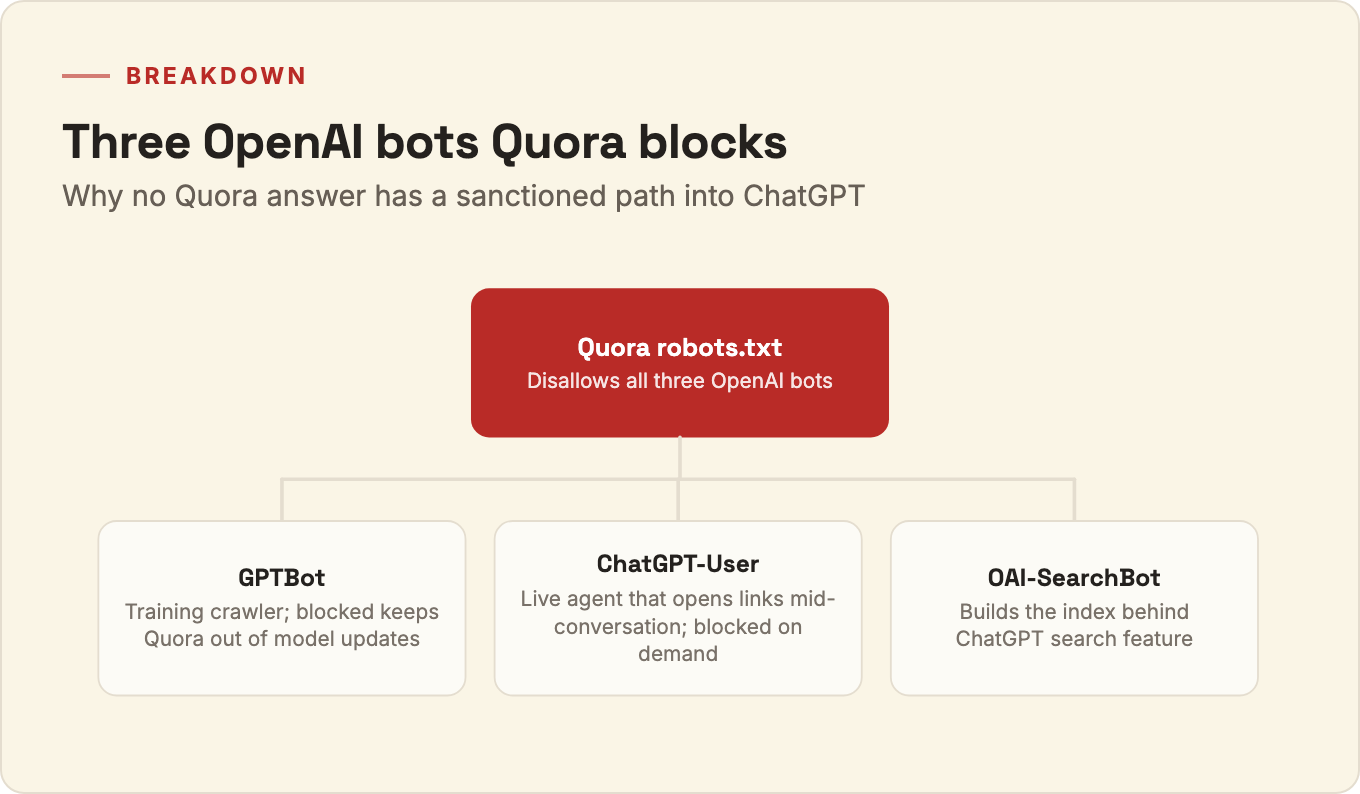
ChatGPT does not use Quora as a direct, permitted source. Quora's robots.txt explicitly disallows OpenAI's crawlers, blocking both GPTBot (used for training) and ChatGPT-User with a site-wide Disallow rule. That means Quora has told OpenAI's fetchers not to read its pages, both for model training and for the browsing agent that ChatGPT uses to open links during a conversation.
The block goes further. Quora also disallows OpenAI's OAI-SearchBot in robots.txt. That bot matters because OAI-SearchBot is the crawler that surfaces websites inside ChatGPT's search feature. In OpenAI's own words, "OAI-SearchBot is used to surface websites in search results in ChatGPT's search features." If a site blocks that bot, it is opting out of the index that feeds ChatGPT's search answers.
It helps to separate the three bots, because they do different jobs. GPTBot is the training crawler, so blocking it keeps Quora content out of future model updates. ChatGPT-User is the live agent that fetches a page when the model decides to open a link mid-conversation, so blocking it stops ChatGPT from reading a Quora URL on demand. OAI-SearchBot builds the search index behind ChatGPT's search feature. Quora disallows all three, which is why there is no clean, sanctioned path for a Quora answer to feed a ChatGPT response.
So on paper, Quora has closed every front door OpenAI uses: training, live fetching, and search indexing. If you are optimizing for AI visibility, the practical takeaway is that a Quora answer is not a reliable route into ChatGPT the way a directly crawlable page on your own domain would be. When you can control and open the door yourself, an AI engine can walk in. When the platform bolts it shut for everyone, you inherit that block whether you like it or not.
If Quora blocks the crawlers, why does it still show up in ChatGPT sometimes?
Because a block on the search crawler does not erase a site from ChatGPT entirely. OpenAI states that sites opted out of OAI-SearchBot will not be shown in ChatGPT search answers, though they can still appear as navigational links. That single sentence explains the confusion: a domain like Quora can be absent from the substantive, cited search results while still appearing as a plain link when the model already knows the URL or the user is clearly looking for it.
There are a few other ways Quora material leaks into AI answers even with the crawlers blocked. Quora threads get quoted, scraped, and republished across the open web, and those secondhand copies are not blocked. Older training snapshots may predate the current robots.txt rules. And navigational intent, where someone effectively asks the model to point them at Quora, is handled differently from a research query where the model assembles an answer from cited sources.
The distinction to hold onto: showing up as a navigational link is not the same as being a cited source that shapes the answer. A navigational link is the model handing back a URL you basically already asked for. A citation is the model choosing your content to build its answer and crediting it. For anyone trying to influence what AI engines say, the second one is what counts, and Quora does not deliver it inside ChatGPT.
Does Perplexity use Quora as a source?
Perplexity does not lean on Quora either, and here the reason is partly the same and partly different. On the crawler side, Quora blocks Perplexity's PerplexityBot in robots.txt, so it does not permit Perplexity's crawler to fetch its pages directly. On the behavior side, Perplexity is not answering from a frozen training set. It operates as a live web-search engine, pulling from a continuously refreshed index of ranked web results. Perplexity's own documentation describes its search as "real-time access to ranked web search results from a continuously refreshed index."
That combination matters. A live search engine leans hardest on whatever it is allowed to fetch and rank right now. When a major source blocks the crawler, that source loses its natural advantage in a real-time system. A frozen model can at least fall back on what it once absorbed during training. A continuously refreshed index has less reason to reach for a source it is told not to crawl, because there is usually something else it can rank instead. So the question "does Perplexity use Quora" runs into the same wall as ChatGPT: the crawler is disallowed, and the citation data backs up that Quora is not a heavy Perplexity source.
What do the large citation studies show about Quora in AI answers?
The independent studies agree: Quora shows up meaningfully in Google AI Overviews and almost nowhere else. Two separate large-scale analyses reached the same conclusion using different data sets.
Profound analyzed roughly 680 million AI citations from August 2024 through June 2025. In that data, Quora appeared prominently only in Google AI Overviews, cited at 1.5% of overall citations and comprising 14.3% of its top-10 sources. It did not feature prominently in ChatGPT or Perplexity. In other words, the one place Quora earns real citation share is Google's AI Overviews, not the two engines this article is about.
Ahrefs found the same pattern from a different angle. Its study covered approximately 76.7 million Google AI Overviews, 957,000 ChatGPT prompts, and 953,500 Perplexity prompts during June 2025. Quora reached the top 10 only on Google AI Overviews, with a 3.6% mention share, and did not crack the top 10 for ChatGPT or Perplexity. Two studies, two methodologies, one result: Quora's AI citation strength is concentrated in Google AI Overviews.
Here is a side-by-side view of where Quora actually gets cited.
| Engine | Profound (680M citations, Aug 2024 to Jun 2025) | Ahrefs (June 2025) |
|---|---|---|
| Google AI Overviews | 1.5% overall, 14.3% of top-10 sources | 3.6% mention share, in the top 10 |
| ChatGPT | Not prominent | Did not crack the top 10 |
| Perplexity | Not prominent | Did not crack the top 10 |
Quora versus Reddit: why the comparison keeps coming up
The reason people keep pairing Quora with Reddit is that Reddit is the user-generated source that actually dominates AI citations, and it makes Quora's smaller footprint obvious by contrast. In the Profound data, Reddit, not Quora, dominates user-generated citations: 6.6% of Perplexity's overall citations (46.7% of its top-10 sources), 2.2% on Google AI Overviews, and second overall on ChatGPT at 1.8%. Ahrefs saw the same gap, with Reddit at 7.4% mention share on Google AI Overviews against Quora's 3.6%.
The gap is not just academic. Reddit sued Perplexity in New York federal court on October 22, 2025, alleging illegal scraping. In its lawsuit, Reddit said its user posts had become the most commonly cited source for AI-generated answers on Perplexity, and that after it sent a cease-and-desist letter, Perplexity increased the volume of citations to Reddit "forty-fold." That is a company fighting over how heavily an AI engine cites it. Quora is not in that fight, which tells you something about its current standing as an AI source.
The Reddit case also underlines a point that runs through this whole topic: crawler access and citation volume are linked. Reddit's forty-fold claim is a dispute about how much a source gets pulled once an engine is fetching it. Quora sits on the other side of that line. It has told the engines not to fetch at all, so it never enters the high-volume citation tier that Reddit is now litigating over. Two user-generated giants, two opposite postures toward AI crawlers, two very different citation footprints in the data.
None of this makes Quora worthless. It makes Quora a specific tool with a specific payoff surface: Google AI Overviews, plus the indirect and correlation effects covered next.
Can a Quora presence still help you get cited by ChatGPT?
There is one data point suggesting an indirect, correlational link, and it deserves an honest label. SE Ranking's data indicates a correlation between Quora presence and ChatGPT citations: domains with heavy Quora presence (about 6.6 million mentions) averaged 7.0 ChatGPT citations, versus 1.7 for domains with minimal presence (up to 33 mentions). That is a real gap in the data.
Read it carefully, though. This is a correlation, not proof that ChatGPT is reading Quora and citing your domain because of it. Given that Quora blocks OpenAI's crawlers, the more likely mechanism is that brands with a heavy Quora footprint also tend to have broad web presence overall, which is what ChatGPT can actually see and cite. Quora participation may be a symptom of visibility rather than the direct cause of a citation. We flag this as medium-confidence for exactly that reason.
The numbers are still worth sitting with. Domains at the heavy end averaged roughly four times the ChatGPT citations of domains at the minimal end. Even if the cause is broad visibility rather than Quora itself, brands that show up on Quora at scale are usually the same brands showing up everywhere else that AI engines do read. The lesson is not "post on Quora and ChatGPT will cite you." It is that the kind of presence which produces millions of Quora mentions tends to travel with the kind of presence AI engines reward, and you want to be building both rather than chasing one channel in isolation.
The practical version: building a Quora presence can be part of a wider strategy that raises your name across the web, and that wider presence is what AI engines reward. Treat Quora as one input into overall AI visibility, not as a direct pipe into ChatGPT's citations.
So where does that leave Quora for AI search?
It leaves Quora as a Google AI Overviews play with indirect upside elsewhere, not a ChatGPT or Perplexity citation engine. Pulling the threads together:
- ChatGPT does not crawl Quora directly. Quora blocks GPTBot, ChatGPT-User, and OAI-SearchBot in robots.txt, so Quora is opted out of ChatGPT's search index and its live fetching.
- Perplexity is a real-time search engine, and Quora blocks PerplexityBot too, so Quora loses its natural advantage in a system that rewards what it can freshly crawl.
- Two large studies (Profound at 680 million citations, Ahrefs across tens of millions of AI Overviews and hundreds of thousands of prompts) agree Quora only reaches the top tier in Google AI Overviews.
- Reddit, not Quora, is the dominant user-generated source across engines, and it is important enough that Reddit is litigating over how it gets cited.
- A heavy Quora presence correlates with more ChatGPT citations, but that is best read as a sign of broad web visibility, not a direct crawl-and-cite path.
If your goal is to be named and cited by AI engines, the move is not to bet everything on one platform. It is to build citable presence across the surfaces AI engines actually read, and to use Quora where it pays: Google AI Overviews and the halo effect of a wider footprint.
Want your brand cited when buyers ask ChatGPT, Perplexity, and Google AI Overviews about your category? That is the focus of our Quora AI visibility service. We build the kind of presence that AI engines pick up, measure where you already appear, and target the surfaces where a citation actually moves buyers. Start there if you want AI answers to work in your favor instead of your competitors'.