

Quora is a question-and-answer platform where people ask questions, get useful answers, and share what they know. So how does Quora work in practice? The community asks and answers questions, votes on the best responses, and a personalized feed matches those questions and answers to the topics and people each reader follows. The result is a large library of answers written by people who have real experience with the subject.
This guide explains how Quora works from the ground up: what happens when you ask or answer a question, how the feed decides what you see, why the community keeps quality high, and what all of that means if you are looking at Quora for marketers. If you want the business angle in one place, our overview of Quora for business covers the strategy side. This page covers the mechanics.
How does Quora work?
Quora works by having the community ask and answer questions. When you want to know more about something, Quora delivers answers and content from people who know the answer, including real doctors, economists, screenwriters, police officers, and military veterans. The platform is built around a simple loop: someone poses a question, other people write answers, and readers vote the most helpful answers toward the top.
That loop is the core of the whole product. A question is a permanent page. It can be asked once and then answered by dozens of people over months or years, and it stays live and searchable the entire time. Unlike a social feed where posts disappear within hours, a strong Quora answer can keep collecting views long after it was written, because it is attached to a question that people keep searching for.
The platform describes itself plainly: Quora is a place to ask questions, get useful answers, and share what you know with the world. In everyday use, that means you can go to Quora to find advice, ideas, perspectives, explanations, and answers to things you have always wondered about.
What is Quora used for?
People use Quora to find advice, ideas, perspectives, and explanations. It sits somewhere between a search engine and a community. You can type a specific question and read what practitioners actually think, rather than reading a company's marketing page about the same topic.
The questions run across almost every subject: career decisions, software choices, health concerns, travel, history, relationships, and highly technical niches. Because answers come from individuals rather than brands, the tone is usually first-person and grounded in experience. Someone answering a question about running a restaurant is often a person who has run one.
This is also why Quora is valuable for research. If you want to understand how your customers describe their problems, the questions they ask on Quora are close to their real language. You can see what they are confused about, what they compare, and what objections come up before they buy.
Getting started as a reader
The recommended way to start is to build a good feed by following topics and people and by taking actions in the feed that tell Quora what you like. Follow the topics that match your interests, follow people whose answers you value, and upvote answers you find helpful. Each of those actions teaches the platform what to put in front of you, so the feed gets sharper the more you use it. Within a short time, the home feed becomes a stream of questions and answers in the areas you care about most.
How does the Quora feed decide what you see?
Your Quora home feed is personalized based on the topics and people you follow. When you follow a topic, questions and answers tagged with that topic appear in your feed. Follow more topics and more people, and the feed widens to match.
Following is only half of it. Quora also learns from the actions you take. You build a good feed by following topics and people and by taking actions in the feed that tell Quora what you like. Every time you open an answer, upvote something, or keep reading, you are giving the system a signal about what to show you next.
The practical takeaway is that the feed is not one universal ranking. Two people who follow different topics see very different Quora. For a marketer, this means your answers do not just compete for a single front page. They surface to the specific readers who follow the topics your answer is tagged with, which is closer to targeted distribution than broadcast.
The role of topics
Topics are the tagging system that connects questions to feeds. A question about email deliverability might be tagged with topics like email marketing and SaaS. Anyone following those topics can have that question, and the answers under it, show up in their feed. Getting the right topics attached to a question is part of how an answer finds the audience it deserves.
How does Quora keep answer quality high?
Upvotes are the main way Quora surfaces good answers. When you see a good answer on Quora, you upvote it. Those votes help other people see good answers and, in the platform's own words, make Quora better. The more helpful an answer is, the more upvotes it tends to collect, and the higher it tends to sit under a question.
This matters more than it first appears. On a question with thirty answers, most readers only see the top few. Upvotes decide which answers those are. An answer that earns votes from readers can climb above answers posted years earlier, so quality, not just seniority, drives visibility.
For anyone using Quora as a marketing channel, the lesson is direct. You cannot force your way to the top with a thin, promotional answer. The answer has to genuinely help the person who asked, because other readers are the ones voting it up or leaving it buried. That constraint is what keeps the platform useful, and it is why a real answer beats a sales pitch every time.
How big is Quora's audience?
According to Quora's investor Andreessen Horowitz, Quora has a community of more than 400 million users looking for knowledge and expertise. That scale is the reason the platform is interesting to marketers at all. A question you answer today can be read by a slice of a very large, intent-driven audience: people who are actively searching for answers, not passively scrolling.
The intent is the important part. Someone reading a Quora question has already articulated a problem. They are further along than a person who just saw an ad. When your answer is the one that helps them, you are reaching a reader at the moment they are trying to make a decision.
Why Quora matters for marketers
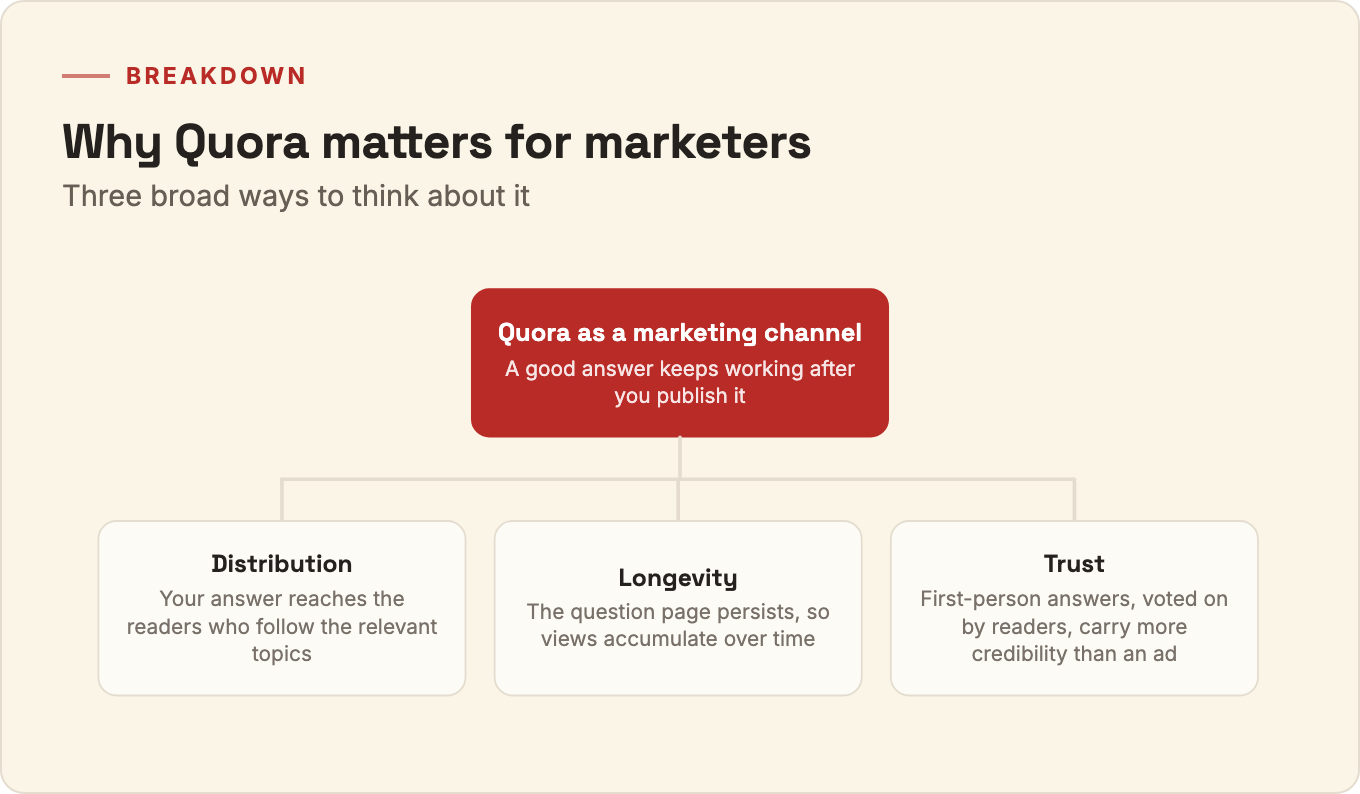
For marketers, Quora is a place to reach people who are actively asking questions your product can answer. The mechanics we have covered so far, permanent question pages, a personalized feed, and upvote-driven ranking, combine into a channel with a long tail. A good answer keeps working after you publish it.
There are three broad ways to think about it. First, distribution: your answer reaches the readers who follow the relevant topics. Second, longevity: the question page persists, so views accumulate over time. Third, trust: because answers are first-person and voted on by other readers, a helpful answer carries more credibility than an ad. This is the foundation of Quora answer marketing, where the goal is to write genuinely useful answers on questions your buyers are already reading.
The catch is that the same quality bar that keeps Quora useful also disqualifies lazy marketing. If your answer does not help the person who asked, it will not earn upvotes, it will not climb, and it may be flagged. The channel rewards the same thing the platform rewards: real, useful answers from people who know the subject.
It also changes how you should measure the work. Because a question page is permanent and keeps drawing readers, the value of an answer is not the traffic it gets in week one. It is the total audience it reaches over its lifetime as people keep finding the question through the feed and through search. That is a very different rhythm from paid ads, where spend stops and traffic stops with it. On Quora, the answer you write this month can still be earning views and upvotes a year from now.
How Quora answers show up in Google and AI search
Quora answers do not just live on Quora. They also surface in Google and in AI answer engines, which extends their reach far beyond the platform's own feed. This is where the marketing value compounds, and it is worth understanding why.
Google has said it wants to surface helpful information that lives in unexpected or hard-to-find places: a comment in a forum thread, a post on a little-known blog, or an article with unique expertise. Its helpful content ranking system shows more of these hidden gems in Search when they improve the results. A strong Quora answer is exactly this kind of hidden gem: first-hand expertise on a specific question.
Google judges content on what it calls E-E-A-T, which stands for experience, expertise, authoritativeness, and trustworthiness, and of these, trust is the most important. Google rewards people-first content, meaning content created primarily for people and not to manipulate rankings. A Quora answer written by someone with direct experience of the topic lines up naturally with that standard, which is part of why these answers can rank.
Quora and AI answer engines
The same content also feeds AI search tools. Perplexity works by searching the internet in real time and including numbered citations in each answer that link back to the original sources it drew on. ChatGPT search answers questions using information from the web and provides links to the relevant sources, including blog posts, which readers can open through a Sources button.
Both behaviors point the same direction. When these tools answer a question, they cite and link the sources they used. A well-written, widely-read Quora answer is a candidate to be one of those cited sources. That means a single answer can influence what people read on Quora, what Google surfaces, and what an AI engine cites, all from one piece of writing.
This is why the quality-first approach is not just an ethics point, it is the strategy. The signals that get an answer cited by Perplexity or ChatGPT, or surfaced by Google as a hidden gem, are the same signals that get it upvoted on Quora: genuine experience, a clear answer to the actual question, and information a reader can trust. Write for the person asking, and you satisfy every one of these systems at once. Write for the algorithm, and you tend to satisfy none of them.
Putting it together
Quora works as a loop: the community asks questions, people who know the subject answer them, readers upvote the best answers, and a personalized feed delivers those answers to the people following the relevant topics. Scale a good answer across a large, intent-driven audience, add the fact that these answers can rank in Google and get cited by AI tools, and you have a channel that keeps working long after publication.
The one rule that runs through all of it is quality. The feed, the upvotes, Google's helpful content standard, and the AI engines all reward the same thing: answers that genuinely help the person asking. Understand that, and you understand how Quora works, and why it is useful for marketing.
If you want to turn this into a real channel for your business, that is exactly what we do. See how Quora works for business and how we build answer campaigns that reach buyers while they are still asking questions.
Sources
- Quora Help Center: What can I use Quora for?
- Quora Help Center: How do I get started using Quora?
- Andreessen Horowitz: Investing in Quora and Poe
- Google Search Central: Creating helpful, reliable, people-first content
- The Keyword (Google): New ways to find helpful information on Search
- Perplexity Help Center: How does Perplexity work?
- OpenAI: Introducing ChatGPT search