
Most businesses ask how long does Quora marketing take because they want a date on the calendar. The honest answer is a range, not a date. A well-written Quora answer can start pulling in on-platform readers within days, but search-driven and AI-driven visibility usually builds over several weeks as Google crawls, indexes, and starts trusting the page. Quora marketing is a compounding play, not an overnight one.
How long does Quora marketing take to show results?
Expect two clocks running at once. The first is Quora's own audience, which can find a strong answer almost immediately through topic feeds and on-site search. The second is external search and AI visibility, which depends on Google. Once you publish an answer, Google still has to crawl and index the page before it can appear in search results or feed AI Overviews, and Google is explicit that this discovery process is not instant. In its own words, crawling "can take anywhere from a few days to a few weeks."
That is why serious Quora marketing is planned in weeks and months, not hours. The answer goes live fast, but the search engines and answer engines that carry it to a wider audience move on their own schedule.
Why the Quora results time is a range, not a fixed date
Even when you actively ask Google to recrawl a URL, there is no guarantee it will be indexed or ranked. Google states plainly that "requesting a crawl does not guarantee that inclusion in search results will happen instantly or even at all." So the Quora marketing timeline is a range because it depends on factors outside any marketer's direct control: crawl frequency, index decisions, and how your answer stacks up against everything else competing for the same query.
What affects the Quora marketing timeline?
Answer quality is the single biggest lever on speed. Google says its systems "prioritize the fast inclusion of high quality, useful content," which means a genuinely helpful, well-sourced answer tends to earn visibility faster than a thin, promotional one. The same content that ranks better also tends to get indexed sooner, so quality pays twice.
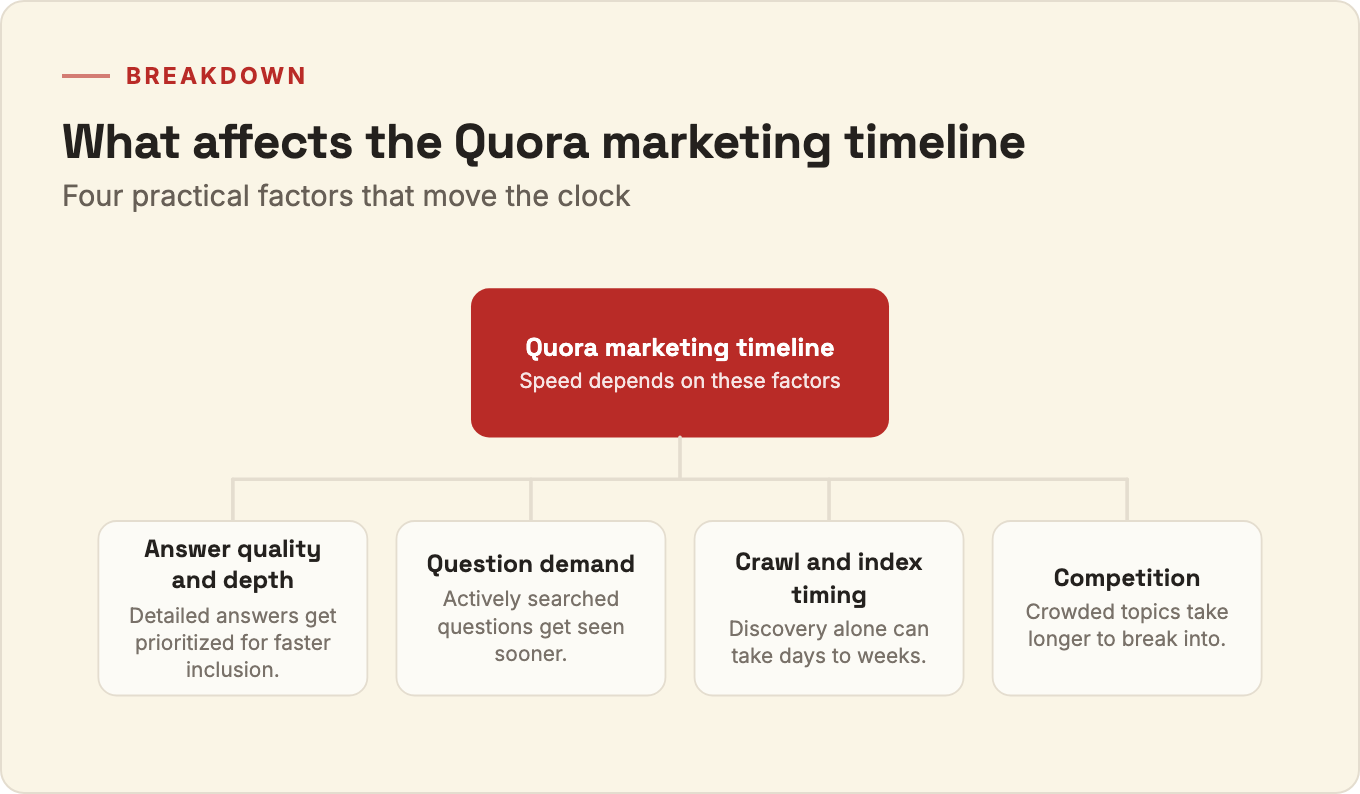
A few practical factors move the clock:
- Answer quality and depth. Detailed, useful answers get prioritized for faster inclusion.
- Question demand. Answering questions people actively search shortens the path from indexed to seen.
- Crawl and index timing. Discovery alone can take days to weeks before anything shows in search.
- Competition. Crowded topics take longer to break into than underserved ones.
When does Quora marketing work through AI answers?
Quora marketing increasingly works through AI answer engines, and that channel can move faster than traditional rankings. AI answer engines search the live web and attach source links in real time, so once a Quora answer is indexed it can begin appearing in AI-cited answers rather than waiting for a full ranking cycle. OpenAI describes ChatGPT search as giving "fast, timely answers with links to relevant web sources."
Quora is a real source for these systems, not a fringe one. Profound's citation analysis found Quora accounts for roughly 1.5% of Google AI Overviews citations, and a separate study of AI-search citations ranked Quora seventh among the most-cited domains, with 360,239 mentions across Google's AI results. That is why an indexed Quora answer can start earning citations well before it would win a top organic position.
Why does Quora marketing keep working after the timeline?
Quora marketing keeps compounding because the platform's scale keeps sending readers to old answers. Quora reports over 400 million monthly unique visitors coming to the site looking for answers, so a well-placed answer accumulates views long after it is published. Unlike a paid ad that stops the moment the budget ends, an evergreen answer stays live, stays indexed, and keeps collecting readers month after month.
This is the core reason the early wait is worth it. The first few weeks buy you an asset. Once an answer is indexed and starts earning views and citations, each additional month adds cumulative traffic rather than resetting the counter. The timeline is front-loaded with patience and back-loaded with compounding return.
A realistic Quora marketing timeline
| Phase | Rough window | What is happening |
|---|---|---|
| On-platform reach | Days | Quora's own feeds and search surface strong answers to its audience. |
| Crawl and index | Days to weeks | Google discovers and indexes the answer page before it can rank. |
| Search and AI visibility | Weeks onward | Indexed answers begin ranking and getting cited in AI answers. |
| Compounding reach | Months | Evergreen answers accumulate views from Quora's 400M monthly visitors. |
Treat these as ranges, not promises. Google itself declines to guarantee timing or inclusion, so any agency quoting an exact date is guessing.
Getting the timeline working for you
The fastest path through the timeline is to publish genuinely useful answers on questions people actually search, then let indexing and AI citation do the compounding. If you want that done consistently rather than in one-off bursts, our team can plan and run it for you. See how we work on the Quora marketing agency page, and we will map a realistic timeline to your goals before any answer goes live.