

Quora ranks answers with a proprietary algorithm that sorts them by relevance and quality, not by raw vote count. It weighs upvotes and downvotes, how credible the voters and the author are, and machine-learned signals about content quality and engagement. Answers that break Quora's policies can be collapsed or discounted, so lasting visibility comes from being genuinely useful rather than from chasing votes.
How does Quora rank answers?
When several people answer the same question, Quora decides the order those answers appear in. It ranks them with a weighted scoring system rather than a raw vote tally. Co-founder Charlie Cheever described the approach as "somewhat similar to PageRank," while noting the signals available on Quora differ from those on the web. The goal has stayed consistent: put the most helpful answer at the top of each question page. Quora's engineering team describes it plainly, saying answer ranking "ensures that the most relevant answers are ranked on the top for a given question." That ordering is the first thing a visitor sees, so the top slots tend to capture the most attention and clicks on a question page.
What signals feed the Quora algorithm?
Quora co-founder Adam D'Angelo published the core principles of the answer ranking system. The exact model changes over time, but the stated logic is stable:
- Answers with more upvotes are ranked higher, and answers with more downvotes are ranked lower.
- A vote from a user who has written good answers in the past carries more weight, for both upvotes and downvotes.
- Answers written by users who have written good answers in the past are ranked higher.
- Votes from accounts detected to be gaming the system, through vote collusion, spam, or bullying, are ignored or minimized.
- Being an admin or reviewer does not change an answer's score.
The takeaway is that a Quora upvote is not a flat unit. The system reads who is voting and who wrote the answer, which is why a handful of votes from credible accounts can outweigh a larger number of low-signal votes.
Is Quora answer ranking just about upvotes?
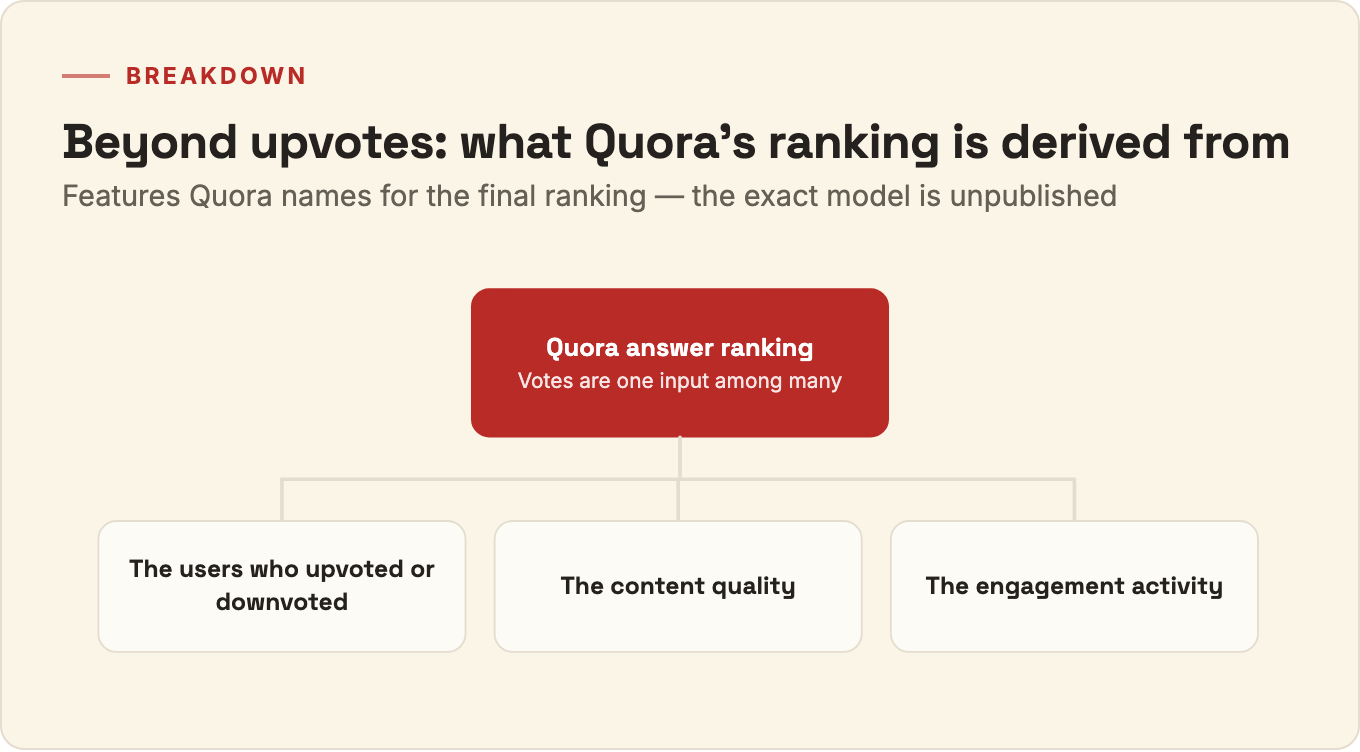
No. Votes are one input among many. Quora's engineering team has said the ranking runs on machine learning and looks well past the vote tally. In their words, these ranking systems "go beyond simple upvotes and downvotes and use features derived from the users who upvoted or downvoted the content, the content quality, the engagement activity etc. to come up with the final ranking."
In practice that means the Quora algorithm evaluates the answer itself, not only the reaction to it. Quora names "content quality" and "engagement activity" as inputs but has not published the exact features, so treat the specifics as informed inference: content-quality signals plausibly reflect substance, clarity, and evidence, while engagement signals reflect how readers interact with an answer. Either way, Quora sorting rewards answers that readers actually find worth reading.
How much does credibility matter?
Credibility sits at the center of Quora answer ranking. The rule that answers from authors with a track record of good answers rank higher means the algorithm carries your history from one answer to the next. A new account writing its first answer starts with little credibility, while an author whose past answers earned genuine upvotes from credible readers carries a stronger author-level signal.
This is why credentials and consistency matter more than volume. Steady, accurate answers in a defined subject area build the author-level signal that lifts future answers. For brands, that is the core of a durable Quora SEO strategy: earn credibility with real expertise before expecting the algorithm to promote your answers.
How do BNBR and moderation affect visibility?
Ranking is not the only filter. Quora enforces a "Be Nice, Be Respectful" (BNBR) policy that requires people to treat each other with "civility, respect, and consideration." Under it, people should be civil in disagreement and "should not: make attacks or otherwise disparage other people, refer to other people's content with insulting or disrespectful language, or harass others on the site."
BNBR is a visibility issue as much as a conduct issue. Content that violates it can be removed or actioned regardless of how many upvotes it holds, so a combative answer can lose its place no matter how popular it is.
Why does Quora collapse answers?
Collapsing hides an answer behind a click, which effectively removes it from normal view even when it is not deleted. A research summary reproducing Quora's moderation policy describes reviewers who had "the right to collapse and flag potentially problematic questions and answers," while admins could edit, delete, and ban. Quora has since changed the specifics of these moderator roles, but collapse remains a live mechanism.
For marketers, collapse is the main risk to manage. Thin, off-topic, or openly promotional answers are the most likely to be hidden, which wipes out any ranking they might have earned. A collapsed answer is not just lower in the order, it sits below a link that many readers never expand, so its practical reach drops sharply. Disclosing affiliations and answering the actual question, rather than pitching, keeps an answer eligible to rank. That is the practical line between spam and effective Quora answer marketing.
Does timing or recency change Quora sorting?
Quora has not published recency as a ranking factor for answers. Its stated signals are quality, credibility, and engagement, and because those change over time, an answer's position is not fixed. A strong new answer can climb as it collects votes from credible readers, and an older answer can slip once better ones appear.
Some practitioners report that early engagement helps, with one community member observing that "the best way to have a viral answer is to get a good number of upvotes in a short amount of time after its publication." Quora has not confirmed any velocity weighting, so treat this as an unverified community observation rather than a documented rule. The reliable move is to publish answers good enough to earn early upvotes on merit.
What the Quora algorithm means for marketers
The Quora algorithm rewards the same things a careful reader would: relevant answers, written by credible authors, that people upvote and engage with, inside the platform's conduct rules. There is no shortcut in vote-buying, because votes from flagged accounts are discounted and policy violations can collapse an answer outright. It also means results compound, since each credible answer you publish strengthens the author signal behind the next one, so consistency pays off more than a single burst of activity.
To earn cited, high-ranking answers, focus on genuine expertise, clear writing, disclosed affiliations, and consistency in a defined topic. If you want help turning that into a repeatable program, our Quora SEO service builds author credibility and answer quality the way the algorithm actually rewards.
Sources
- TechCrunch: Quora Details Their New Answer Ranking Scheme (quoting co-founders Adam D'Angelo and Charlie Cheever)
- Forbes / Quora Engineering: How Does Quora Use Machine Learning In 2017?
- Wikimedia Meta-Wiki: Online Community Conduct Policies, Quora (reproducing Quora's BNBR and moderation policy)
- Indie Hackers: Quora answer ranking (practitioner discussion)