

To avoid a Quora ban, follow one rule above all others: contribute genuinely useful answers and stop treating the platform as a link farm. Quora bans accounts for spam, coordinated inauthentic activity, and using multiple accounts to evade moderation. Stay clear of those behaviors and your account stays safe.
Below is what actually triggers enforcement, how Quora escalates before it bans you, and how to keep a marketing presence on the platform without crossing the line.
Why does Quora ban accounts?
Quora bans accounts for a defined set of actions, not vague reasons. According to Quora's own help documentation, the actions that can result in a ban include posting the same content repeatedly, sharing irrelevant answers or comments to drive traffic to an external site or for monetary gain, coordinated inauthentic activity such as vote manipulation, harassment, and using multiple accounts to evade moderation.
Two themes run through every one of these. The first is spam: repetitive, self-serving posting that adds nothing for readers. The second is deception: manipulating engagement or hiding behind multiple accounts. If your activity avoids both, you are already ahead of most marketers who end up with a Quora account ban.
What Quora counts as spam
Quora's Platform Policies spell out spam explicitly. It includes posting the same content repeatedly, and doing any of the following to drive traffic to an external site or for monetary gain: posting irrelevant answers or comments, editing your questions to include links or irrelevant information, posting questions to promote a business or service, or excessively promoting the same product or service.
Coordinated inauthentic activity such as vote manipulation is also classified as spam, as is promoting products or services that artificially manipulate engagement metrics, like selling accounts, followers, likes, or reviews. If your growth plan depends on buying engagement, that plan is a ban waiting to happen.
How to avoid a Quora ban
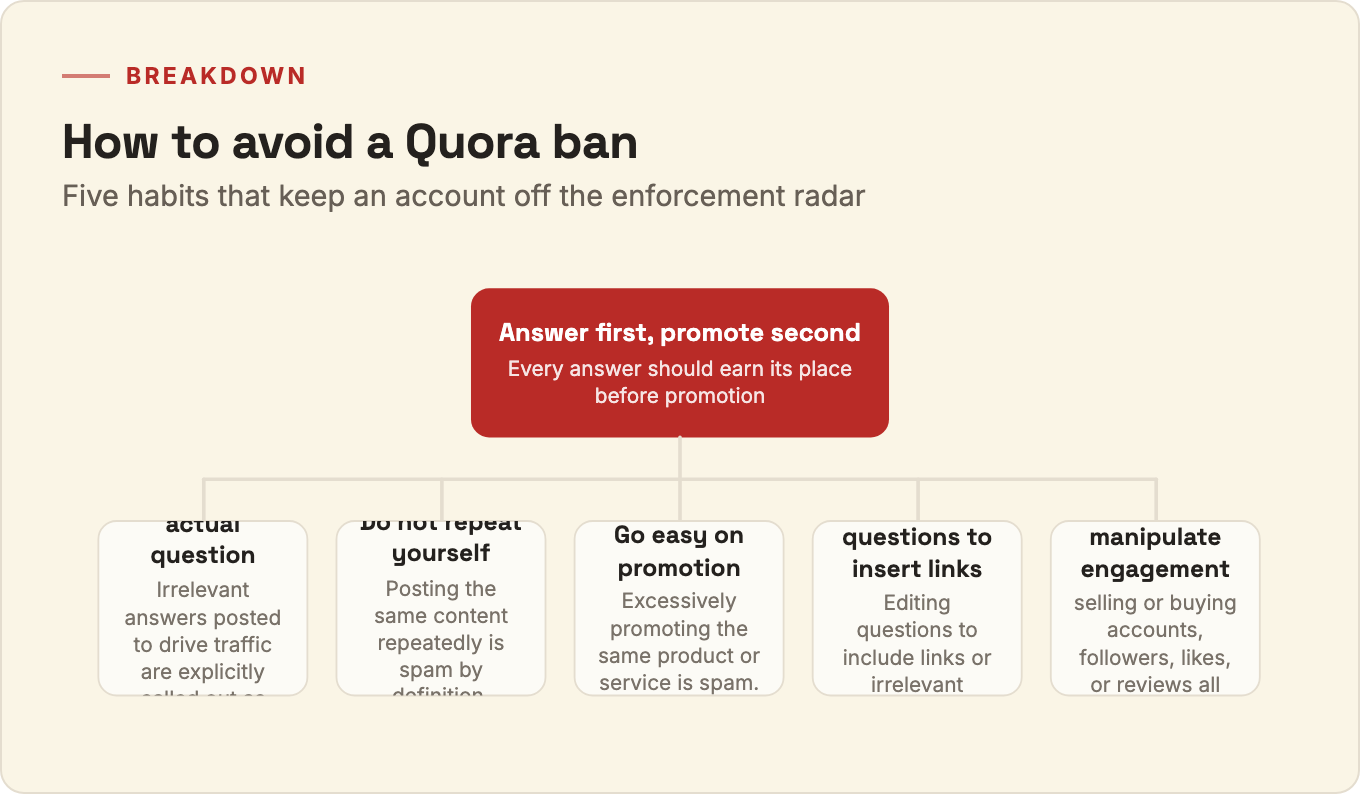
The way to avoid a Quora ban is to make every answer earn its place before you think about promotion. The link, if there is one, should be a citation for a genuinely helpful answer, not the reason the answer exists. Here is how that translates into daily practice.
- Answer the actual question. Irrelevant answers posted to drive traffic are explicitly called out as spam. If your answer would not stand on its own without the link, do not post it.
- Do not repeat yourself. Posting the same content repeatedly is spam by definition. Write each answer fresh for the specific question, even when the topics overlap.
- Go easy on promotion. Excessively promoting the same product or service is spam. Most of your contributions should carry no link at all.
- Do not edit questions to insert links. Editing questions to include links or irrelevant information is listed as spam behavior.
- Never buy or manipulate engagement. Vote manipulation, coordinated inauthentic activity, and selling or buying accounts, followers, likes, or reviews all count as spam.
- Run one honest account. Using multiple accounts to fake or manipulate engagement, engage in targeted reporting, or bypass enforcement is prohibited outright.
Why multiple accounts are a fast way to get banned
Using multiple accounts to evade moderation is one of the actions Quora names directly as grounds for a ban. The Platform Policies go further, prohibiting the use of multiple accounts to fake or manipulate engagement, engage in targeted user or content reporting, or bypass and evade enforcement actions.
This matters because a common reaction to a first warning is to spin up a backup account. That single move converts a recoverable situation into a clear policy violation. If one account gets flagged, fix the behavior on that account rather than starting over somewhere Quora can link back to you.
Does Quora warn you before a ban?
Usually, yes. Quora states that when a person violates a policy multiple times, they will typically receive content warnings and/or a temporary edit-block before being banned. Those warnings are your early signal to change course, not noise to ignore.
There is an important exception. Severe violations of Quora's Terms of Service or Acceptable Use Policy can result in an immediate ban with no warning at all. So the warning system is a safety net for ordinary mistakes, not a guaranteed number of free passes.
Quora's Acceptable Use Policy describes a range of enforcement: written warnings, removal of content, warning tags added to content, and the limitation or termination of a user's access to Quora. Quora also states that it holds sole authority and the final decision on whether content or behavior violates its policies. In practice, that means there is no arguing a technicality. Play well inside the lines.
What to do if you are banned in error
If you believe your account was banned in error, Quora lets you appeal the decision by filling out a contact form. Keep your appeal factual and specific about why the ban does not fit your activity. An appeal only helps if your track record actually supports it, which is another reason to keep your contributions clean from day one.
Marketing on Quora without the ban risk
You can absolutely market on Quora. The businesses that last are the ones that treat the platform as a place to be genuinely helpful first and visible second. That means a steady stream of substantive answers, restrained linking, a single authentic account, and zero engagement manipulation.
If that sounds like more discipline than your team can sustain alongside everything else, that is exactly the work we handle. Our Quora profile management service builds and maintains presence the way the policies require, so your account grows without tripping the enforcement wires described above.
Want a Quora presence that drives real visibility without risking a ban? Take a look at our Quora profile management service and let us handle the day-to-day the safe way.