
To choose a Quora marketing agency, judge it on three things: whether its answers genuinely help the person asking, whether it works within Quora's own rules and Google's spam policies, and whether it can show real experience rather than generic claims. The best Quora marketing agency earns citations by being useful and trustworthy, not by buying links or padding answers with promotion. This guide covers the exact criteria to use before you hire a Quora agency.
Why does the choice of Quora agency matter so much?
The choice matters because Quora is a real distribution channel with real reach, and the wrong partner can waste that reach or put your brand at risk. Quora reports that more than 400 million unique visitors come to the platform every month looking for answers. That is a large audience, and Quora describes it as high-intent: people who are actively researching, evaluating products, and receptive to new solutions. That receptiveness is exactly why marketers have found success on the platform, and it is also why the wrong approach stands out. An audience that evaluates carefully notices when an answer is a thinly veiled ad.
There is a second reason the choice matters now. User-generated content has become a significant source that AI answer engines cite. A large study of AI answer engines analyzed roughly 230,000 prompts and over 100 million citations across ChatGPT search, Google AI Mode, and Perplexity, and it found that user-generated content domains such as Reddit, YouTube, and Facebook were among those cited most. At its peak, ChatGPT cited Reddit in close to 60% of prompt responses before that share fell back to around 10% later in the period. Earned Quora answers sit in the same category of user-generated content that AI engines pull from, so the quality of what an agency publishes affects not just Quora traffic but your visibility inside AI answers too.
Put those two facts together and the stakes are clear. You are placing your brand in front of a large, high-intent audience on a platform whose content increasingly shapes AI answers, and the person doing the placing is the agency you hire. Get that choice right and the work compounds. Get it wrong and you are paying someone to publish content that helps no one, breaks platform rules, and never gets cited.
How to choose a Quora marketing agency: the core criteria
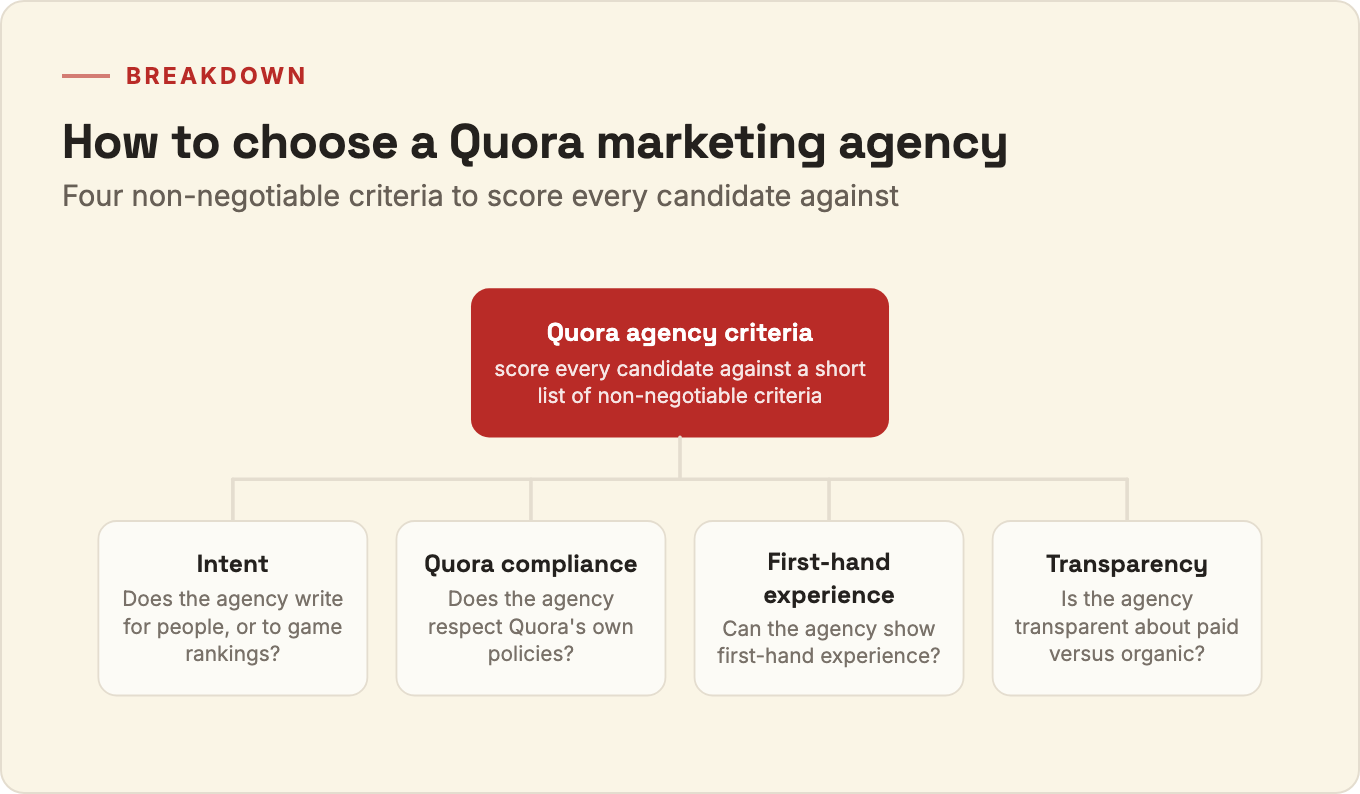
To choose a Quora marketing agency, score every candidate against a short list of non-negotiable criteria: the intent behind the content, compliance with Quora and Google policy, demonstrated first-hand experience, transparency, and a clear line between organic and paid work. Below is each criterion and the question it should answer.
1. Does the agency write for people, or to game rankings?
The first Quora agency criterion is intent. Google rewards people-first content, which it defines as content created primarily for people and not to manipulate search engine rankings. Google goes further and says the single most important question to ask about any content is "Why is it being created in the first place?" A good agency answers that question honestly: the answer exists to help the person who asked. A weak agency writes answers whose real purpose is to place a link or a brand name, and readers and ranking systems both tend to spot the difference.
When you review samples, read them as if you were the person who posted the question. Does the answer actually solve the problem before it mentions the client? If the promotion comes first and the help comes second (or never), that is a signal to walk away.
2. Does the agency respect Quora's own policies?
The second criterion is Quora compliance. Quora's Question and Answer Policies prohibit self-promotion that does not form part of a direct, helpful response to the question. In practice that means a compliant agency leads with genuine value and treats any brand mention as a supporting detail inside a useful answer, not as the point of the post. Ask a prospective agency how it handles client mentions. If the method is to drop links into as many threads as possible, it conflicts with Quora's rules and will not last.
3. Can the agency show first-hand experience?
The third criterion is experience. In Google's guidance on helpful content, one of the questions used to judge quality is whether the content clearly demonstrates first-hand expertise, for example expertise that comes from having actually used a product or service, or visiting a place. The best Quora answers show real experience rather than generic claims that could apply to anyone. Ask how the agency reaches that level of specificity: does it interview your team, use your product, and gather concrete details, or does it produce interchangeable answers that never prove anyone touched the thing being described?
4. Is the agency transparent about paid versus organic?
The fourth criterion is transparency. Quora itself draws this line clearly. Its paid product, Promoted Answers, is labeled "Promoted" for transparency, which keeps advertising visibly separate from organic contribution. A trustworthy agency keeps the same separation in its own work and tells you plainly which results come from earned, organic answers and which come from paid placement. This matters because trust is the foundation of the whole model. In Google's E-E-A-T framework, trust is the most important component, which is why an agency's answers must be accurate and openly attributed to earn citations over time.
What are the red flags when you hire a Quora agency?
The clearest red flag when you hire a Quora agency is anyone who sells links or promises to buy your way up the search results. Google defines link spam as the practice of creating links primarily to manipulate search rankings, so a legitimate Quora agency must not buy or sell links to move a client up the SERP. Google's spam policies explicitly list exchanging money, goods, or services for links as link spam. That rules out any agency that advertises "guaranteed backlinks" or paid link placements as a core service.
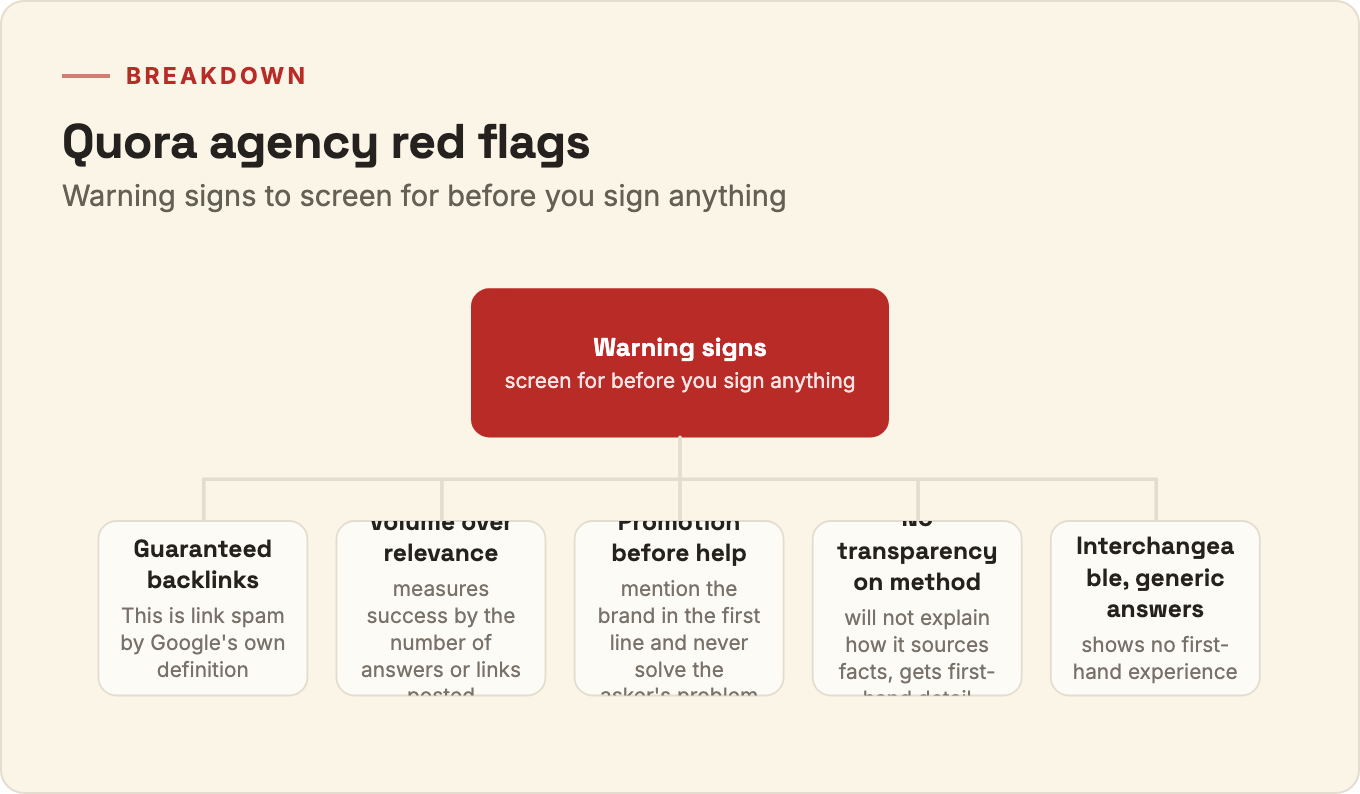
Here are the warning signs to screen for before you sign anything:
- Guaranteed backlinks or paid link placement. This is link spam by Google's own definition (exchanging money for links or posts that contain links), and it puts your site at risk rather than helping it.
- Volume over relevance. An agency that measures success by the number of answers or links posted, rather than by how well those answers serve the question, is optimizing for the wrong thing.
- Promotion before help. Sample answers that mention the brand in the first line and never solve the asker's problem conflict with Quora's policy on self-promotion.
- No transparency on method. If an agency will not explain how it sources facts, gets first-hand detail, or separates organic answers from paid ones, you cannot verify that the work is safe or genuine.
- Interchangeable, generic answers. Content that shows no first-hand experience is exactly what Google's helpful-content guidance flags as low quality.
None of these red flags require inside knowledge to spot. You can catch all of them by reading three or four sample answers closely and asking two or three direct questions about method.
What questions should you ask before signing?
Ask questions that force the agency to reveal its intent, its compliance, and its process. The answers separate a real partner from a link vendor. Use this checklist on your first call:
- Why would someone find this answer helpful? This is Google's own "why" test. A good agency can explain the reader value of any answer it writes before it mentions ranking or reach.
- How do you handle client mentions inside an answer? The right answer describes brand mentions as part of a direct, helpful response, consistent with Quora's policy, not as the reason the answer exists.
- How do you get first-hand detail about my product? Look for a concrete process: interviews, product access, documentation review. Generic reassurance is not enough.
- Do you ever buy or sell links? The only acceptable answer is no. Anything else is link spam under Google's policies.
- How do you separate organic answers from paid promotion? A trustworthy agency mirrors Quora's own labeling and tells you which results are earned and which are paid.
What does a genuinely helpful Quora answer look like?
A genuinely helpful Quora answer solves the asker's problem first, proves it was written by someone with real experience, and treats any brand mention as a footnote rather than the headline. This is the standard the criteria above are built to protect, and it is worth spelling out because it is what you are actually buying when you hire a Quora agency.
Start with intent. Google says the most important question about any piece of content is why it exists, and a helpful Quora answer exists to serve the person who asked. Layer on experience: Google's helpful-content guidance asks whether the content demonstrates first-hand expertise, such as expertise that comes from having actually used a product or service. A strong answer includes the specific, concrete detail that only comes from real use, which is also what makes it credible enough to be trusted and cited. Then respect the platform. Quora's Question and Answer Policies prohibit self-promotion that does not form part of a direct, helpful response, so the brand mention has to sit inside a response that stands on its own merit. An answer that meets all three tests reads like advice from a knowledgeable peer. An answer that fails them reads like an ad, and both the reader and the ranking systems treat it that way.
How does a good Quora agency connect to AI visibility?
A good Quora agency connects to AI visibility because the same qualities that make an answer helpful also make it citable by AI engines. The study of roughly 230,000 prompts and over 100 million citations across ChatGPT search, Google AI Mode, and Perplexity confirmed that AI engines cite specific web sources, and that user-generated content domains such as Reddit rank among the most-cited types. That is the practical payoff of the people-first, experience-driven approach described above. Answers written to genuinely help, grounded in first-hand detail and accurate enough to trust, are the answers most likely to be pulled into an AI-generated response where your brand can appear.
This is why the criteria are not academic. Intent, compliance, experience, and transparency are not just ethics checks. They are the properties that decide whether your Quora presence gets cited by AI answer engines or ignored. An agency that treats Quora as a link farm produces content that neither Quora, Google, nor AI engines have reason to surface. An agency that treats Quora as a place to be genuinely useful produces content that all three can reward.
Putting the criteria together
The best Quora marketing agency for you is the one that passes every criterion at once: it writes for people, respects Quora's Question and Answer Policies, shows real first-hand experience, stays transparent about paid versus organic, and never buys or sells links. A single failure among these is enough to disqualify a candidate, because each one maps directly to a Google policy or a Quora rule that governs whether the work is safe and effective. Use the red-flag list to screen out link vendors quickly, then use the five questions to confirm that the agencies still standing actually operate the way they claim.
If you want to see what a compliant, help-first approach looks like in practice, our Quora marketing service page lays out how we produce earned answers that lead with genuine value and stay inside both Quora and Google policy. Read the sample answers, ask us the five questions above, and hold us to the same criteria you would apply to anyone else. The goal is a Quora presence that helps real readers, earns citations honestly, and shows up where high-intent audiences and AI answer engines are already looking.
Ready to hold a partner to this standard? Start with our Quora marketing agency page for a straight account of how we work, then judge us against every criterion in this guide before you commit.