

To find the right Quora questions to answer, search your keywords, topics, or phrases in the Quora search bar and filter to the "Questions" tab, then keep only questions where you have real experience and where a lot of people are looking for the answer. That combination, genuine expertise plus broad demand, is what separates a question worth your time from one that will sit unread. Everything below is how to work that filter in practice.
Where do you find questions to answer on Quora?
Start inside Quora itself. Quora's own guidance tells answerers to search keywords, topics, or phrases in the search bar and then click the "Questions" tab to see live questions on that subject. This is the fastest way to build a working list of quora questions to answer, because you are reading exactly what people are asking right now, in their own words.
Run a search for every core topic tied to your product or service. Then scan the results for questions that are still open, still getting activity, and phrased the way a real customer would phrase them. Save the strong ones. You are not answering yet, you are building a shortlist you can rank.
Search by topic, not just single keywords
Quora advises choosing questions in topics where you have insider information, first-hand experience, or actionable advice to share, rather than picking questions at random. So search at the topic level, follow the topics that match your expertise, and let the question feed surface fresh threads for you over time. A topic you know cold will keep producing questions you are genuinely qualified to answer.
What makes the best Quora questions to answer?
The best Quora questions to answer sit where two things overlap: you have something real to say, and a large number of people want to hear it. Miss either side and the answer underperforms. Here is how to judge both.
Filter for genuine expertise
Only shortlist questions where you can add insider information, first-hand experience, or advice someone can act on. This is not just Quora's advice, it is how search rewards content too. Google's people-first guidance asks whether content clearly demonstrates first-hand expertise and depth of knowledge, the kind that comes from actually using a product or service. If you are guessing, skip the question. If you have lived it, that is your answer to write.
Weigh the demand behind the question
Prioritize more general questions with broad appeal. Quora notes that its most popular answers have received millions of views, and answers addressing common questions or offering unique insights tend to perform well. Demand is why targeting matters at all: over 400 million unique visitors come to Quora every month looking for answers, so a question with wide interest gives your answer far more room to be seen than a narrow, low-traffic one.
Balance the two signals. A broad question you can answer from real experience beats both a niche question only three people care about and a huge question you can only answer in generalities.
How do you prioritize quora question targeting?
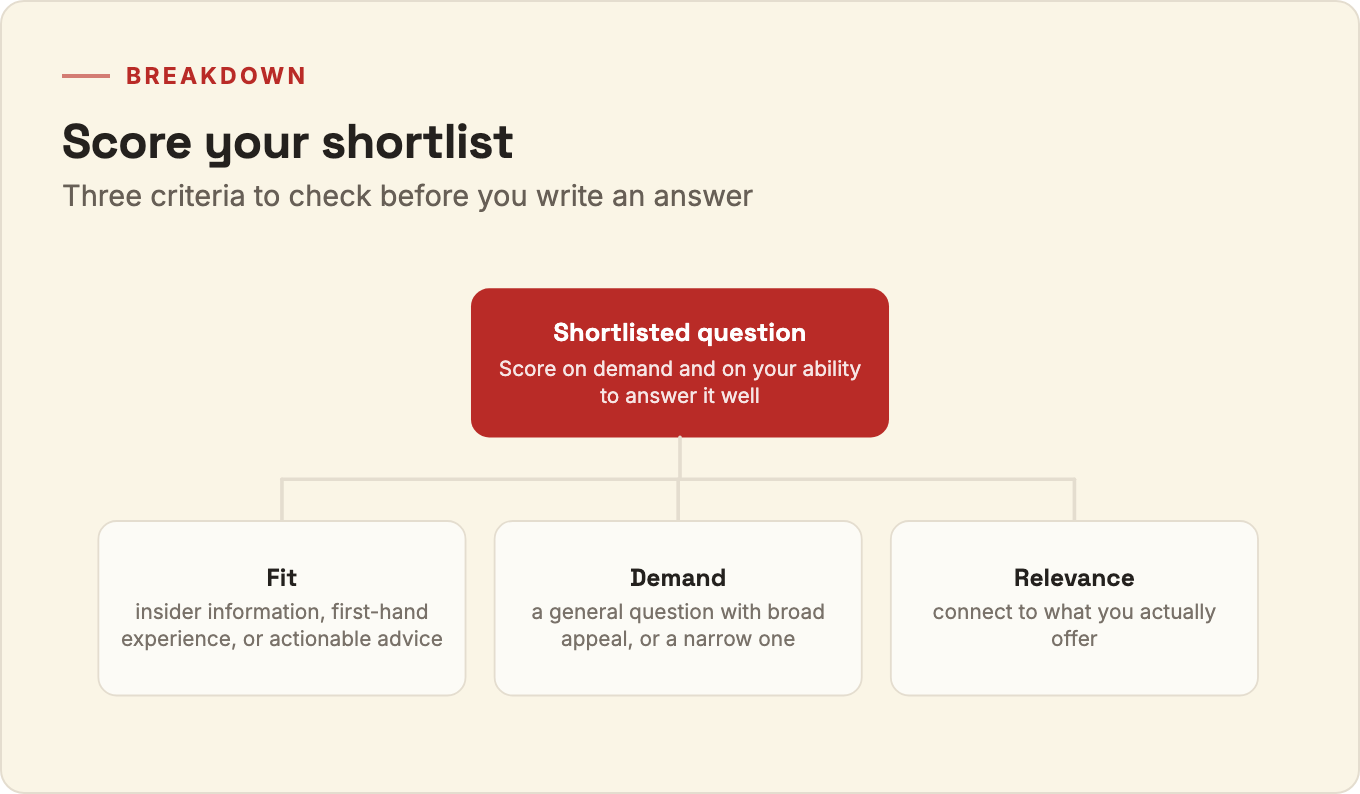
Prioritize by scoring each shortlisted question on demand and on your ability to answer it well, then work the top of that list first. Quora question targeting is a ranking exercise, not a volume exercise. You do not need every question, you need the right few.
A simple way to sort your shortlist:
- Fit: Do you have insider information, first-hand experience, or actionable advice for this exact question? If no, drop it.
- Demand: Is this a general question with broad appeal, or a narrow one only a handful of people ask?
- Relevance: Does answering it naturally connect to what you actually offer, so a reader who wants more has a reason to click through?
Questions that score high on all three go first. This is the core of Quora answer marketing: putting real, useful answers in front of the questions your future customers are already asking.
Why does answering the right questions compound?
The right question keeps paying you back long after you post, which is why targeting is worth the effort up front. Your answers live permanently on Quora and continue to drive organic traffic long after a campaign ends. A well-chosen answer is not a one-day spike, it is an asset that keeps working.
That compounding reaches beyond Quora. Google's helpful content system surfaces "hidden gems," including comments in forum threads, particularly when it thinks they improve the results. A strong Quora answer to a real question can earn visibility in Search on top of the traffic it gets on Quora. AI answer engines extend the same logic: Perplexity describes its platform as built on real-time, web-wide research and Q&A, so answering the questions people actually ask puts your content in the pool those engines draw from. Pick the question well once, and it can surface in three places.
How often should you find and answer questions?
Treat it as a consistent habit, not a one-off blast. Quora recommends writing one to three answers a week in the 500-word range, consistently. That cadence should shape how you find questions too: you are looking for a steady supply of strong, on-topic questions, not a single burst you exhaust in a weekend.
Build the habit around your saved topics. Each week, revisit your followed topics and searches, pull the best new questions into your shortlist, score them for fit and demand, and answer the top one to three. Over a few months this quietly produces a library of targeted answers, each one a permanent asset pointed at real demand.
Put targeting to work
Finding the right Quora questions is the part that decides whether the writing pays off. Search your topics, filter to questions you can answer from real experience, rank them by demand and relevance, and answer consistently. If you would rather have that research, targeting, and answering handled for you, our Quora answer marketing service does exactly this: it finds the high-demand questions your customers are asking and answers them in a way that keeps drawing traffic long after they go live.