

To use Quora for content marketing, you answer real questions your buyers are already asking, back each answer with credible sources and first-hand experience, and organize your best material inside a branded Space so it works as an owned content hub. The platform sends people who are researching and evaluating, not idly scrolling, which is why a single strong answer can keep earning attention long after you publish it.
This guide walks through why Quora fits content marketing, how to pick the right questions, how to write answers that both people and search engines trust, and how to build a repeatable program instead of one-off posts.
Why does Quora work for content marketing?
Quora works for content marketing because its audience arrives with intent. Over 400 million unique visitors come to Quora every month looking for answers, which gives content marketers a built-in pool of people actively searching for solutions rather than passively consuming a feed. That distinction matters: intent is what turns a piece of content into a lead.
Quora describes itself as a high-intent destination that sits somewhere between search and social, a place where people conduct research, evaluate products, ask for tips, and learn more about the world. That behavior maps directly to mid- and bottom-funnel content marketing goals. When someone asks which tool solves a specific problem or how to approach a decision, they are already partway to a purchase, and a helpful answer meets them at that exact moment.
The platform also covers an enormous range of subjects. Across 24 languages and over 300,000 topics, Quora personalizes content based on what each person wants to learn about. For content marketers, that breadth means almost any niche, however specialized, has relevant questions waiting to be answered. There is rarely a "my industry isn't on Quora" problem; there is usually a "we haven't found the right questions yet" problem.
Where Quora fits in the funnel
Think of Quora content as sitting closest to the consideration and decision stages. People asking questions there are comparing options, looking for advice, and trying to reduce risk before they commit. That makes it well suited to content that explains tradeoffs, shares real experience, and points readers toward a deeper resource when they want more detail.
This is also what separates quora content marketing from most social posting. On a typical feed, you interrupt someone's attention and hope to earn a second of it. On Quora, the reader came looking for the thing you know. You are not fighting for attention; you are supplying an answer that was already being sought. That inversion changes what "good content" means. Instead of maximizing scroll-stopping novelty, you optimize for completeness and credibility, because the person reading has a specific problem and will keep reading as long as you keep helping.
How to use Quora for content marketing, step by step
To use Quora for content marketing, work through four stages: find the right questions, answer them credibly, build an owned hub with Spaces, and connect answers to the rest of your content system. Each stage builds on the last, so the value compounds over time instead of resetting with every post.
Step 1: Find questions worth answering
Start by searching the topics your buyers care about and reading how questions are phrased. Because Quora spans more than 300,000 topics, you can drill down from a broad subject into the narrow, specific questions where your expertise actually helps. Prioritize questions that are close to a decision ("which approach is better for X," "how do I solve Y"), because those attract readers who are ready to act.
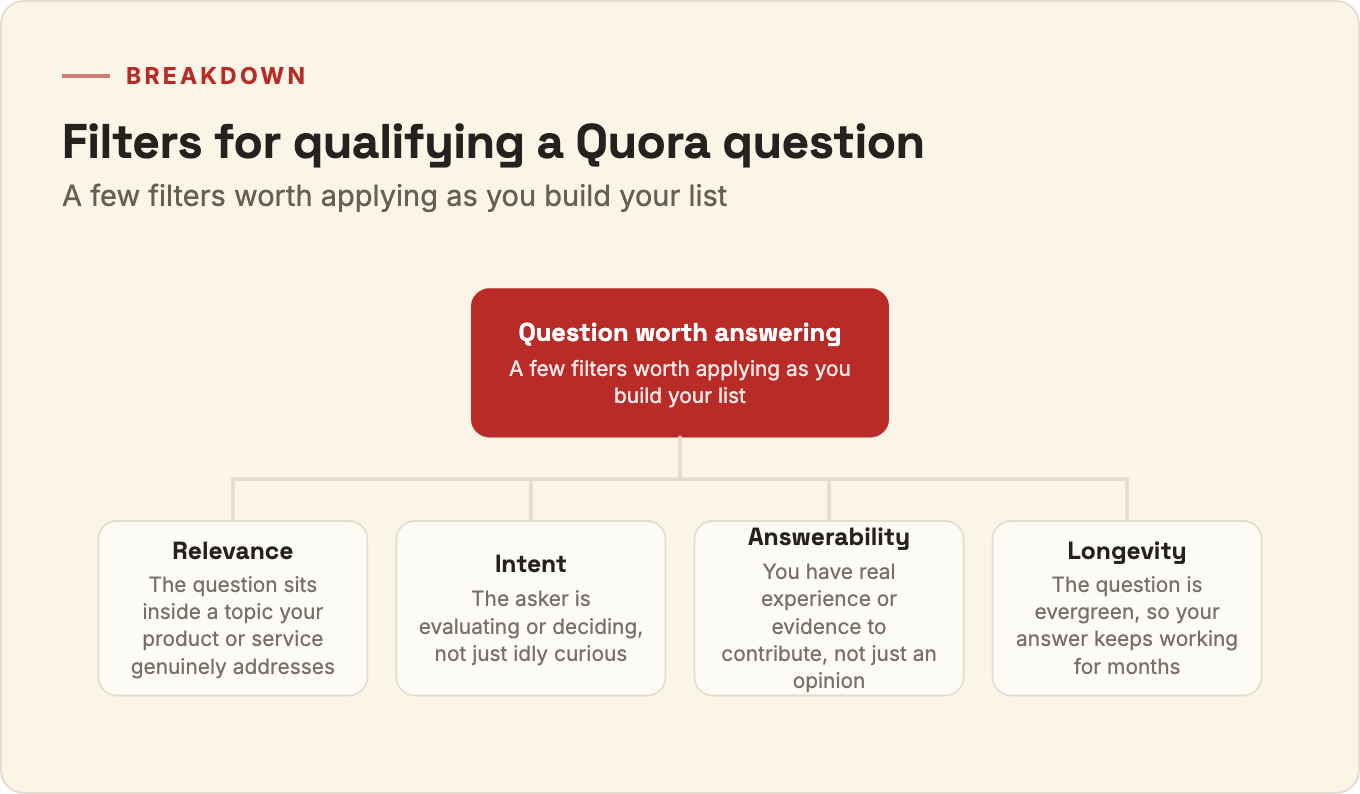
A few filters worth applying as you build your list:
- Relevance: the question sits inside a topic your product or service genuinely addresses.
- Intent: the asker is evaluating or deciding, not just idly curious.
- Answerability: you have real experience or evidence to contribute, not just an opinion.
- Longevity: the question is evergreen, so your answer keeps working for months.
Step 2: Write answers people and search engines trust
The answers that perform are the ones that earn trust. Quora's own guidance says good answers demonstrate credibility and are factually correct by providing reliable sources, listing good examples, and explaining why the author has expertise or first-hand experience in the subject. In other words, the platform amplifies exactly the kind of white-hat, genuinely useful content that serious marketers want to publish anyway.
That standard lines up neatly with how Google evaluates content, which matters because strong Quora answers can also earn organic search visibility. Google defines people-first content as content created primarily for people and not to manipulate search engine rankings. If you write to help the asker rather than to shoehorn in a link, you are already meeting that bar.
Google's E-E-A-T framework sharpens the point. Of its aspects, trust is the most important, and the others contribute to trust. So a Quora answer earns its keep when it is credible and transparent rather than promotional. Google also explicitly rewards content that shows first-hand expertise from actually using a product, service, or place. A good answer should carry that same experience signal: describe what you actually did, what happened, and what you learned.
Authorship matters too. Google's self-assessment for helpful content asks whether it is self-evident who wrote the content and whether pages carry a byline where one would be expected. On Quora, your profile is your byline. A credible answerer identity, with a clear bio and a track record in the topic, is part of what makes the answer trustworthy in the first place.
A practical test before you hit publish: would this answer be useful to the asker even if you removed every mention of your brand? If yes, you have something worth posting. If no, rewrite it.
Step 3: Build an owned hub with Quora Spaces
Once you are answering consistently, give your best material a home. A Quora Space is a place where you can build a dedicated community around one idea, business, or topic, with complete editorial control. That makes a Space function as an owned content hub inside Quora: you decide what gets published, you curate the best questions and answers, and you develop an audience that follows your point of view rather than a single scattered post.
A Space turns individual answers into a body of work. Instead of hoping people stumble onto one good reply, you build a destination where a reader can browse everything you have published on a subject. That is the difference between doing content marketing on Quora and simply posting on Quora.
Editorial control is the part worth dwelling on. Because you decide what appears in your Space, you can shape it around a clear theme and a consistent voice, the same way you would run a blog. You can gather your answers to related questions in one place, add context, and give a newcomer a guided path through your thinking rather than a pile of disconnected posts. Over time that curation is what makes a Space read as a genuine resource instead of a promotional channel, and resources are what people bookmark, share, and return to.
Step 4: Connect Quora to the rest of your content
Quora content should not live in isolation. Treat each answer as an entry point into your wider content system. When an answer naturally calls for more depth than the format allows, that is the moment to point readers to a longer resource on your own site. If you want a structured way to turn answers into a lead channel, our guide to Quora answer marketing covers how to do it deliberately rather than by accident.
The principle is simple: answer the question fully on Quora, then offer a next step for the reader who wants to go further. Done well, quora content marketing feeds your blog, your email list, and your product pages instead of competing with them.
What makes a good Quora answer for marketing?
A good Quora answer for marketing is one that fully resolves the asker's question and happens to reveal your expertise along the way. The mistake most brands make is inverting that order, leading with a pitch and treating the question as an obstacle. Quora's audience is researching, so a thin, promotional answer reads as noise and gets ignored.
Use this checklist as a quick quality gate:
| Signal | What it looks like in an answer |
|---|---|
| Credibility | Reliable sources cited, claims that can be verified |
| Examples | Concrete, specific cases rather than generalities |
| Experience | First-hand detail from actually doing the thing |
| Transparency | Clear author identity, no hidden agenda |
| Usefulness | Answers the question even without the brand mention |
Every row on that list traces back to the same idea from both Quora and Google: content earns visibility when it is trustworthy and helpful first. That is not a constraint on content marketing on Quora; it is the mechanism that makes it work.
Does Quora content help with AI search visibility?
Quora content is worth considering as part of an AI-citation strategy, though the landscape is volatile. User-generated question-and-answer content has become a significant source for AI answer engines. As one measure of how fast this shifts, Semrush reported that ChatGPT cited Reddit in close to 60% of prompt responses in early August before dropping to around 10% by mid-September. The specific numbers move, but the pattern is clear: AI systems pull from community Q&A platforms, and Quora is one of them.
The practical takeaway is not to chase citation counts. It is that the same qualities that make a Quora answer good for people, credible sourcing, real expertise, and factual accuracy, are the qualities that make it a candidate for AI systems to surface. Write for the human asker, and you position the content well for however AI answer engines evolve.
It also argues against treating any single distribution channel as permanent. The swing in how often one platform gets cited is a reminder that visibility can shift quickly and for reasons outside your control. The durable asset is not a ranking or a citation rate; it is a library of trustworthy answers tied to a credible identity. That library keeps its value across whatever surfaces send readers your way, whether that is Quora's own feed, Google, or an AI assistant summarizing the web.
How do you build a repeatable Quora program?
A repeatable Quora program comes from consistency and structure rather than occasional bursts of effort. One great answer is a nice moment; a system that produces good answers every week is a content channel. Here is a workable rhythm:
- Maintain a question backlog. Keep a running list of relevant, high-intent questions so you never start from a blank page.
- Answer on a schedule. A steady cadence beats sporadic effort, and it builds your answerer identity faster.
- Curate into a Space. Move your strongest answers into a branded Space so they compound into an owned hub.
- Link outward with purpose. Point readers to deeper resources only when it genuinely serves them.
- Review what resonates. Notice which questions and angles draw engagement, and do more of that.
The goal is a program where every answer strengthens the next one. Your profile grows more credible, your Space accumulates depth, and your best answers keep working long after they are published, all because you built content people actually wanted to read.
Getting started
Quora rewards the same things good content marketing has always rewarded: real expertise, honest sourcing, and answers written to help. The platform's high-intent audience and its topic breadth give you the reach, and its guidelines happen to line up with what Google and AI answer engines also reward. That alignment is the whole opportunity. If you want a deliberate, done-with-you approach to turning answers into a lead channel, see our Quora answer marketing service and let us build the program around your questions and your expertise.
Sources
- Quora Business: Reach over 400 million monthly unique visitors on Quora
- Quora Business: Everything you need to know about Quora Spaces
- Quora Help Center: What does a good answer on Quora look like?
- Google Search Central: Creating helpful, reliable, people-first content
- Semrush: Most-cited domains in AI answer engines