
Quora affiliate marketing can work, but only if you treat Quora as an audience channel and not a link-dropping shortcut. Bare answers stuffed with affiliate links get removed as spam, the links themselves pass no SEO value, and Quora Ads ban affiliate URLs outright. What works is genuinely useful answers that build trust first and route interested readers toward a page you actually control.
Below is what the platform rules and Google's own guidance say about doing this properly, and where the real leverage sits.
Can you put affiliate links in Quora answers?
You can post affiliate links in organic Quora answers, but the platform removes answers that exist mainly to push them. Quora defines spam as content whose purpose appears to be directing traffic to external commercial sites while providing little to no value back to the community. An answer that is a thin wrapper around an affiliate link fits that definition, which is how bare-link answers get pulled.
The workable version is the opposite shape: an answer that fully solves the reader's problem, with a link included only where it genuinely helps. The value has to sit in the answer itself, not in the click.
What about Quora Ads?
Paid promotion is stricter. Quora Ads do not allow affiliate links to be used as landing page URLs, and that ban explicitly includes landing pages and websites built for the sole purpose of promoting affiliate links. So you cannot buy your way around the organic rules by pointing an ad straight at an affiliate offer. If you run ads, they have to send traffic to a real property with its own substance.
Do Quora affiliate links help your SEO?
No. Links inside Quora answers pass no direct ranking value. Answers are user-generated content, and Google recommends marking user-generated content links, such as forum posts and comments, with the rel="ugc" attribute. Links carrying Google's nofollow-family attributes are generally not followed or credited for ranking, so a Quora affiliate link hands you no link equity toward your own site.
This matters for expectation-setting. If your plan was to build backlinks by seeding affiliate links across Quora, that plan does not work the way you think. The value of Quora is the human traffic and the visibility, not a boost to your domain's authority.
What are the Quora affiliate rules you actually have to respect?
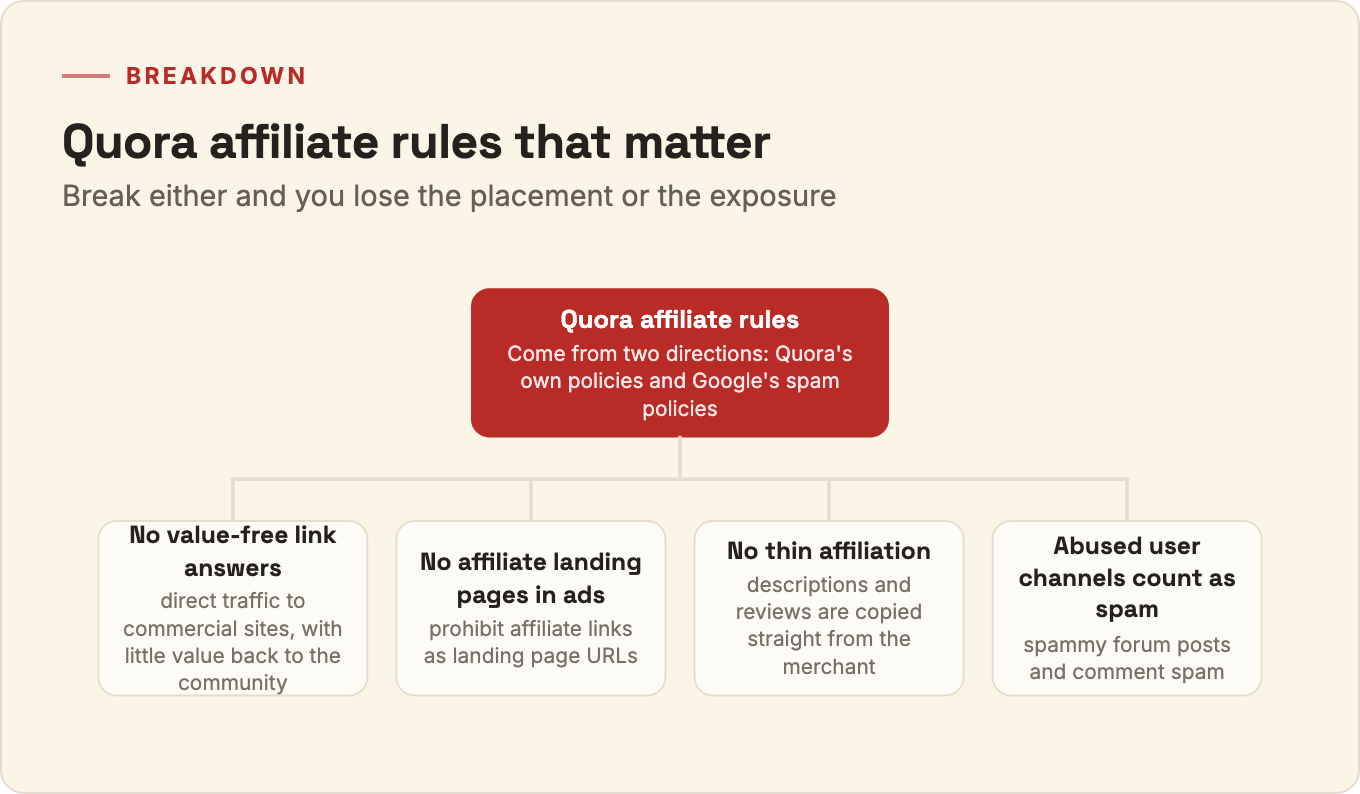
The Quora affiliate rules that matter come from two directions: Quora's own policies and Google's spam policies. Break either and you lose the placement or the exposure.
- No value-free link answers. Quora treats answers whose purpose is to direct traffic to commercial sites, with little value back to the community, as spam.
- No affiliate landing pages in ads. Quora Ads prohibit affiliate links as landing page URLs, including sites built only to promote them.
- No thin affiliation. Google's spam policies define thin affiliation as publishing content with product affiliate links where descriptions and reviews are copied straight from the merchant, with no original content or added value. Copy-paste merchant blurbs are a policy violation, not just weak writing.
- Abused user channels count as spam. Google classifies spammy content added through a channel meant for user content as user-generated spam, with spammy forum posts and comment spam among its listed examples.
The through-line is consistent. Original, useful content is allowed. Content that exists only to move a click is not.
Why send Quora traffic to your own page instead of straight to the offer?
Because the raw offer link is the weakest possible destination, and the platform rules push you off it anyway. Sending readers to a page you own gives you room to add the original content and added value that keeps you clear of thin-affiliation and spam problems, and it lets you capture the reader before handing them to a merchant.
A simple sequence works better than a direct affiliate drop:
- Write an answer that fully addresses the question on its own.
- Where relevant, reference a resource on a site you control, such as a comparison or guide.
- Place the affiliate links on that page, wrapped in real, original content.
This is the core idea behind serious Quora answer marketing: the answer earns attention, and a page you own does the converting. You stay inside the rules and keep control of the reader's next step.
Is Quora still worth it if AI is eating search?
It can be, because AI answer engines pull on user-generated community content, though the payoff is inconsistent. Citation share moves fast: Semrush reported that ChatGPT cited Reddit in close to 60% of prompt responses in early August 2025 before dropping to around 10% by mid-September. Community platforms clearly feed AI answers, but you cannot treat any single one as a reliable, permanent citation source.
The practical read is to build presence on community Q&A for the human audience first, and treat any AI-citation upside as a bonus you do not control. A helpful, well-ranked Quora answer reaches real people today regardless of what the answer engines do next month.
The short version
Quora affiliate marketing rewards patience and punishes shortcuts. Do not drop bare affiliate links, do not expect SEO value from them, and do not try to buy your way past the rules with ads pointed at affiliate URLs. Write answers that stand on their own, keep original content between the reader and the offer, and route traffic through a page you control.
If you want that done at scale and inside the rules, our Quora answer marketing service builds genuinely useful answers that earn visibility and send qualified readers to pages you own. Start there instead of gambling on link drops.