

A strong Quora answer example does three things at once: it answers the exact question in the first sentence, it shows why the writer is credible, and it stays useful to anyone who reads it later. Quora's own guidance points to the same pattern, and so does Google's advice on helpful content. Below are the traits that separate answers people trust from the ones they scroll past, with the sourcing behind each one.
What makes a good Quora answer example?
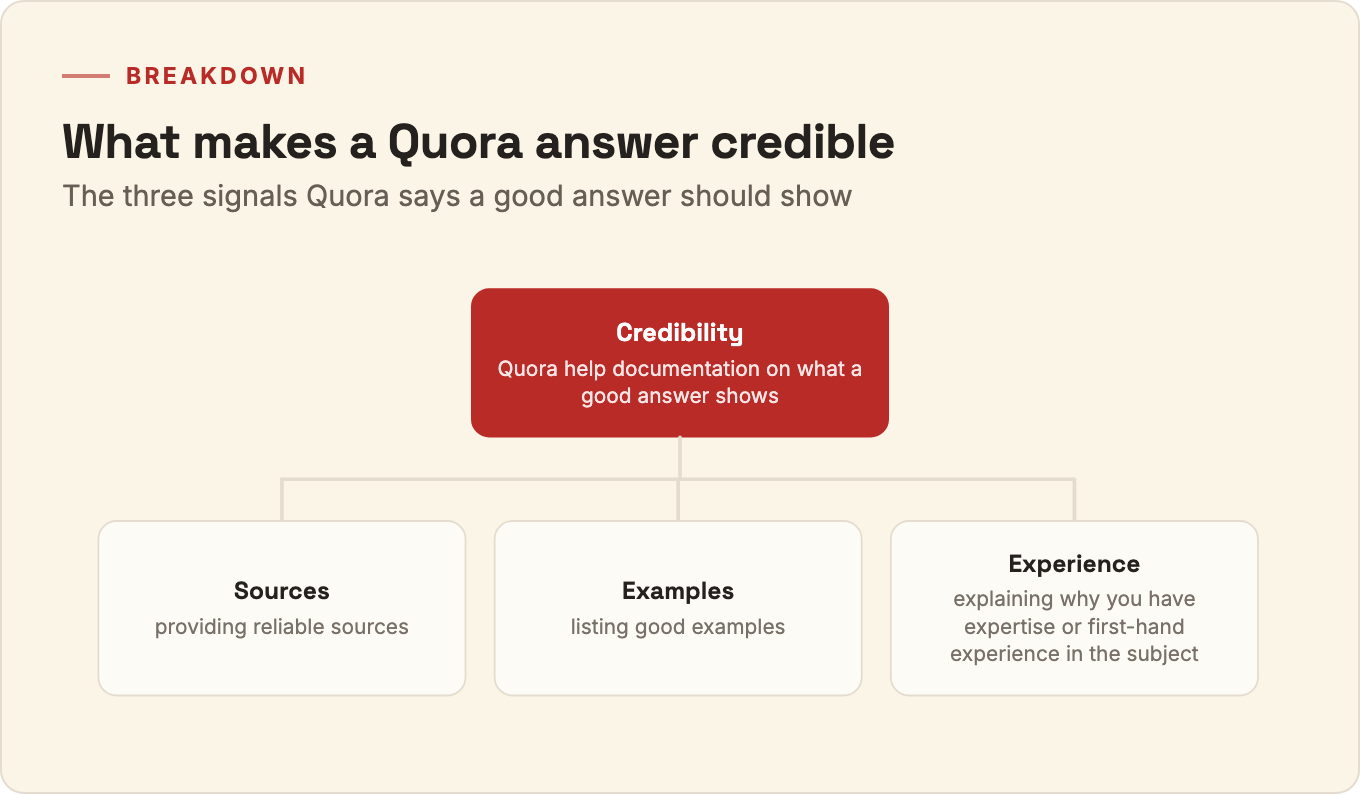
A good Quora answer example demonstrates credibility and answers the question directly. Quora's own help documentation says answers can show credibility in a number of ways, including providing reliable sources, listing good examples, and explaining why you have expertise or first-hand experience in the subject. Those three signals (sources, examples, experience) are the backbone of nearly every answer that earns upvotes and stays visible.
Two more rules from Quora shape what the best answers look like:
- Keep it general and reusable. Quora says a good answer has facts and insights that are general and reusable, and that an answer is not the most helpful if it only helps one person with circumstances not listed in the question.
- Explain the why. Quora advises writers to support answers with rationale, treating every question as if it is implicitly asking "Why?" even when it does not say so. Readers should finish the answer understanding why it is correct, not just what the conclusion is.
How is a Quora answer example structured?
The best Quora answers open with the direct answer, then add structure so the detail is easy to skim. Quora recommends simple formatting that adds structure and highlights key pieces of information, and it expects clear answers with correct spelling, grammar, and punctuation. In practice that means a short lead sentence that resolves the question, followed by short paragraphs, lists, or headers for the supporting points.
A reliable shape for examples of good Quora answers looks like this:
- Lead with the answer. One or two sentences that resolve the question before any backstory.
- Show the evidence. A source, a concrete example, or a note on your first-hand experience.
- Explain the reasoning. Why the answer holds, so a skeptical reader is convinced.
- Close cleanly. A short takeaway the reader can carry to their own situation.
Why do credible answers earn more trust?
Credible answers earn trust because trust is what search engines and readers reward. Google says its systems favor content that shows experience, expertise, authoritativeness, and trust, and that of these, trust is the most important, with the others contributing to it. Google also asks whether content clearly demonstrates first-hand expertise and depth of knowledge, for example expertise that comes from actually using a product or service or visiting a place.
The overlap is the useful part: Quora asks for sources, examples, and first-hand experience, and Google asks for exactly the same signals. An answer built to satisfy one tends to satisfy the other.
That is why the best Quora answers read like they were written by someone who has done the thing, not summarized it. Naming a real source, describing a specific example, and stating plainly where your experience comes from all raise the trust signal at once.
Do AI engines actually cite Quora answers?
Yes. AI search engines pull Quora answers as sources, which raises the stakes on answer quality. In a study of AI citation patterns by Profound, Quora accounted for about 1.5% of total citations and made up 14.3% of Google AI Overviews' top-ten sources. Quora itself notes that brand answers can appear as cited content in Perplexity and Google AI Mode because its question-indexed format is one AI models are trained to extract from.
That format matters more as community and reference sites take a larger share of AI answers. Semrush's study of AI citations found that Reddit and Wikipedia are ChatGPT's two most-cited domains. Question-and-answer content sits squarely in the kind of source these engines favor.
The traffic quality is the payoff. Quora's own internal data reports that visitors who arrive from AI search convert at 4.4x the rate of typical organic traffic. A well-built answer is not just seen, it brings back readers who are ready to act. If you want a structured program around this rather than one-off posts, our Quora answer marketing service is built to place answers that get cited.
How to write your own strong Quora answer
Start from the question and work backward through the same signals every good example shares. Before publishing, check your draft against a short list:
- First sentence answers the question. No throat-clearing.
- At least one credibility signal is present. A source, a concrete example, or a stated reason you know this first-hand.
- It stays general. Someone with a slightly different situation still gets value.
- The reasoning is visible. The reader sees why, not just what.
- Formatting is clean. Short paragraphs or lists, correct spelling and grammar.
Run every answer through that checklist and you are writing to the same bar Quora and Google both reward. These are the quora answer samples worth modeling: direct, sourced, reusable, and honest about where the knowledge comes from.
If your brand needs answers that consistently hit this bar and get pulled into AI search, that is the work we do. See how our Quora answer marketing program turns these principles into placed answers that win traffic and trust.