

A good Quora answer format opens with a direct answer, then breaks the rest into short paragraphs, clear subheadings, and lists so the page is easy to scan. Readers do not read online prose word by word, so the layout has to surface your main points fast. Get the structure right and both people and search engines find your answer easier to trust.
The rules below come from Quora's own formatting guidance and from decades of reading research. They apply whether you write one answer a week or manage a full content program.
Why does Quora answer format matter for readability?
Format matters because people scan instead of reading. Eye-tracking work from Nielsen Norman Group found that on the average web page, users have time to read at most about 28% of the words during a visit, and 20% is more likely. If your key point is buried in a wall of text, most readers never reach it.
Scanning also follows a predictable shape. Readers move through content in an F-shaped pattern, spending most attention on the top and the left edge of each block. That is why the opening and your subheadings carry so much weight: they are the parts people actually see.
How should you structure the opening of an answer?
Put your most important points in the first two paragraphs and answer the question in the first line or two. Nielsen Norman Group recommends leading with the core points because that top zone gets the most attention before readers decide whether to keep going.
A practical opening does three things: it states the answer plainly, it signals that you know the topic, and it sets up the detail that follows. Save context and caveats for lower down, where readers who want depth will keep scrolling.
What formatting tools does Quora recommend?
Quora tells writers to use its built-in tools rather than inventing custom styles. Use the numbered and bullet list functions for all itemized lists, and use the blockquote function to indent quotes. This keeps your answer consistent with the platform's native tools rather than custom styling.
On emphasis, Quora's guidance is restraint. Use bold, italics, and underline sparingly, and avoid block capitals. An answer that is mostly bold or mostly italics loses all emphasis, because nothing stands out when everything is styled.
- Use bold to mark a few genuinely important words or phrases, not whole sentences.
- Reserve blockquotes for actual quotes and standout statements.
- Skip all-caps entirely; it reads as shouting and hurts scannability.
How do you break an answer into scannable chunks?
Split the answer into small chunks using short paragraphs, white space, and contrasting subheadings. Nielsen Norman Group research on chunking shows that presenting content in pieces makes scanning easier and improves how well readers comprehend and remember it.
In practice, that means one idea per paragraph, headings that describe what each section covers, and enough white space that the page never looks dense. A reader should be able to grasp your structure from the subheadings alone before reading a single full sentence.
When should you use bullet points and numbered lists?
Use lists whenever you have a set of items, steps, or options. Bulleted lists are one of the most effective formatting tools for online reading because they break up large blocks of text and make key information stand out. Vertical lists work best when you have three or more items.
Numbered lists suit ordered processes and rankings, where sequence matters. Bullets suit unordered sets where each item is equal. If you only have one or two items, keep them in a sentence; a list of one looks awkward and adds no scanning benefit.
A quick reference for Quora answer layout
| Element | How to use it |
|---|---|
| Opening | Direct answer in the first one to two sentences. |
| Subheadings | Descriptive, contrasting, one per section. |
| Paragraphs | Short, one idea each, with white space between. |
| Bold and italics | Sparingly, on a few key words only. |
| Lists | Bullets for sets, numbers for ordered steps, three or more items. |
| Quotes | Native blockquote function, not custom styling. |
Does clean formatting affect how content ranks?
Yes. Presentation is treated as a quality signal, not just a nicety. Google's people-first content guidance asks whether content is produced well or appears sloppy and hastily produced, and whether it has spelling or stylistic issues. Clean, error-free formatting supports the case that your answer is trustworthy.
That connection is why formatting is part of any serious Quora answer marketing effort. A well-formatted answer is easier for people to read, easier for Quora to surface, and easier for search engines to interpret when they pull Quora content into results.
A simple checklist to format Quora answers
Before you publish, run through a short list. Each item maps to a specific readability gain, so skipping one leaves attention on the table.
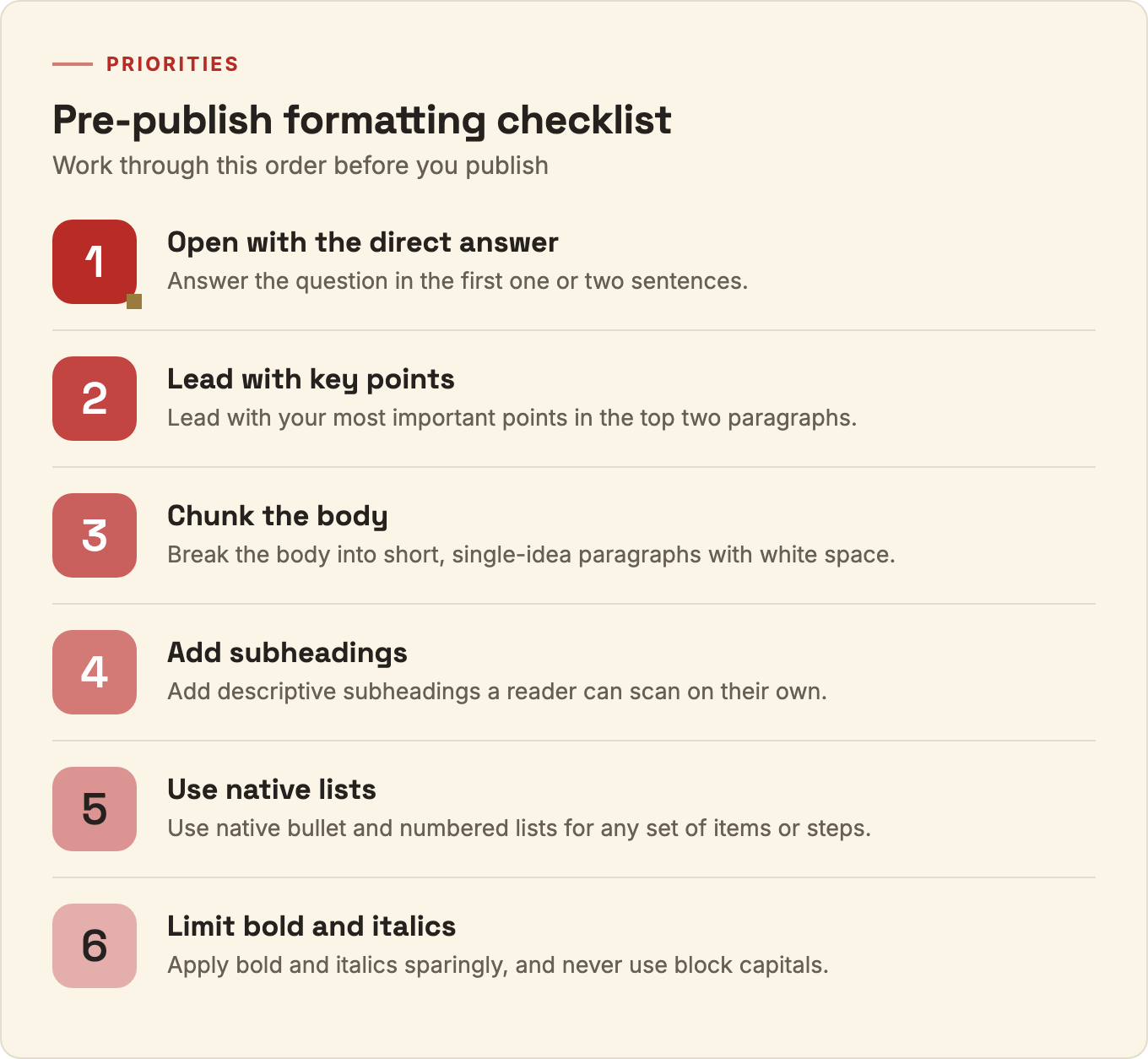
- Answer the question in the first one or two sentences.
- Lead with your most important points in the top two paragraphs.
- Break the body into short, single-idea paragraphs with white space.
- Add descriptive subheadings a reader can scan on their own.
- Use native bullet and numbered lists for any set of items or steps.
- Apply bold and italics sparingly, and never use block capitals.
- Proofread for spelling and style before publishing.
Consistent formatting is the difference between an answer people skim past and one they read and act on. If you want a team that applies these standards at scale across a Quora program, see how our Quora answer marketing service handles structure, sourcing, and publishing so every answer is built to be read.
Sources
- Quora Help Center: Good guidelines for formatting answers and posts on Quora
- Nielsen Norman Group: How Little Do Users Read?
- Nielsen Norman Group: F-Shaped Pattern For Reading Web Content
- Nielsen Norman Group: Chunking
- Nielsen Norman Group: Presenting Bulleted Lists Online
- Google Search Central: Creating Helpful, Reliable, People-First Content