

Quora demographics point to an audience that is large, search-driven and unusually senior. More than 400 million unique visitors come to Quora every month, they skew slightly male and concentrate in the 25 to 34 age group, and a meaningful share hold business buying authority. If you want to know who uses Quora and whether that audience is worth your marketing time, the short answer is that it leans toward educated, decision-ready people looking for answers, not passive scrollers.
Below is a plain reading of the numbers, pulled from Quora's own business figures and third-party traffic estimates, so you can judge the fit for yourself.
What are Quora's demographics in 2026?
Quora's demographics describe a global, professionally skewed audience that arrives mostly through search. The platform draws over 400 million monthly unique visitors across more than 300,000 topics, with the largest single age group being 25 to 34 year-olds and a gender split estimated at roughly 55% male and 45% female. Geographically it is concentrated in the United States, with strong secondary presence in India, the United Kingdom and Canada.
Those are the headline quora user demographics. What makes them interesting for marketers is not the raw size but the composition: Quora reports that its visitors are considerably more likely than average to be senior decision-makers and to control business purchases. That combination of scale and seniority is rare on a public content platform.
How many people use Quora?
Over 400 million unique visitors come to Quora every month, according to Quora's own business figures. Third-party traffic trackers put total visits in the same order of magnitude: Semrush recorded 320.96 million visits to quora.com in May 2026, with an average session duration of over eight minutes.
The two numbers measure different things. Unique visitors count distinct people; visits count sessions, and one person can visit many times in a month. Read together, they describe a site with hundreds of millions of people passing through and spending real time once they arrive. The eight-minute-plus average session is a signal that people read, compare answers and follow threads rather than bounce.
Scale on its own is easy to overrate. Plenty of platforms report big monthly numbers while the average visit lasts seconds. What separates Quora is that the audience size and the time spent both hold up. A visitor who stays past eight minutes is usually reading multiple answers on a question, which is exactly the moment when a considered, well-argued response can influence a decision. For a marketer, that depth of attention is worth more than a larger but shallower audience that leaves before it reads anything.
Who uses Quora, and how senior is the audience?
The people who use Quora skew toward business buyers and workplace decision-makers. Quora reports that its visitors are 67% more likely to be responsible for business purchases and 48% more likely to be senior decision-makers at work than the general population. That is the single most important fact about the Quora audience for anyone selling to companies.
Most social platforms are built for entertainment and reach a broad, mostly consumer crowd. Quora is built around questions, and the questions people bring tend to be research questions: which tool to choose, how to solve a specific problem, whether a product is worth buying. That format self-selects for an audience in a considering or deciding frame of mind, which is why the buyer and decision-maker skew shows up so clearly. If your product is sold to businesses, this is the reason Quora deserves a look as a marketing channel for business.
It helps to read those two figures together rather than separately. Someone who is 67% more likely to control business purchases and 48% more likely to be a senior decision-maker is, in plain terms, the kind of person marketing teams normally spend heavily to reach through paid ads, events and outbound. On Quora they are already present and actively looking for answers. The seniority skew also changes the tone that works: this audience can spot a thin sales pitch quickly, so credibility and specifics carry more weight than volume or repetition.
Where do Quora users come from?
Quora's audience is global but concentrated in a handful of English-speaking markets. The United States is by far the largest source of traffic, accounting for roughly 46.6% of visits in June 2026. India follows at 11.19%, then the United Kingdom at 6.74% and Canada at 4.37%.
| Country | Share of traffic (June 2026) |
|---|---|
| United States | 46.6% |
| India | 11.19% |
| United Kingdom | 6.74% |
| Canada | 4.37% |
The practical takeaway: if your market is North America, the United Kingdom or India, the Quora audience overlaps heavily with your buyers. Nearly half of all traffic is US-based, so a US-focused campaign reaches the biggest slice of the platform. India's large share matters if you sell there or recruit talent there, and the UK and Canada round out a strong English-language core.
The concentration also has a downside worth naming. If your customers sit mainly in non-English-speaking markets, the four countries above cover the large majority of Quora's measured traffic and your fit is weaker. The platform is genuinely global in reach, but its center of gravity is the English-speaking professional world. For most business-to-business sellers targeting the US, UK, Canada or India, that concentration is a feature rather than a limitation, because spend is not diluted across markets you do not serve.
What is the age and gender breakdown of Quora's audience?
The largest single age group on Quora is 25 to 34 year-olds, and the audience skews slightly male. Third-party estimates put the split at about 55.44% male and 44.56% female as of June 2026. Treat these figures as directional rather than exact, since they come from traffic modeling rather than a verified user census.
A 25 to 34 core matters because it maps onto early and mid-career professionals, the people who research tools, evaluate vendors and increasingly sit in buying committees. Combined with the seniority skew Quora reports, the age profile reinforces the picture of a working, professionally engaged audience rather than a teenage one. The slight male lean is worth noting but is close enough to even that most B2B and general-interest topics reach both genders in volume.
One caution on precision: the age and gender figures are modeled estimates from third-party traffic tools, not a verified headcount from Quora, which is why they carry medium rather than high confidence. Use them to set direction, not to make fine distinctions. The safe reading is that Quora's audience clusters around working-age adults with a modest male tilt, and that both the age and gender profiles are wide enough to reach a broad professional audience rather than a narrow niche.
How do people find and use Quora?
Most Quora visitors arrive through search. Semrush data shows Google organic search drives 44.85% of quora.com traffic, followed by direct visits at 36.48%. That makes Quora one of the more search-dependent large platforms, and it changes how marketers should think about it.
Because so much traffic comes from Google, individual Quora answers can keep pulling in readers for months or years after they are posted, as long as they rank for the questions people search. This is closer to how SEO content works than to how a social feed works. A strong answer is an asset that compounds, not a post that disappears in a day. The heavy direct-traffic share, meanwhile, points to a base of repeat users who come back to read and answer on purpose.
The topic breadth supports this: Quora spans more than 300,000 topics, so almost any niche question has a home. For marketers, that means there is very likely an existing, search-visible thread where your category is already being discussed.
This search dependence is a strength if you plan for it and a weakness if you ignore it. The upside is that a single strong answer, ranking for a question your buyers type into Google, can deliver a steady trickle of qualified readers for a long time without further work. The downside is that reach is not guaranteed by posting alone; an answer that no one searches for and that does not rank will sit unseen. Effective Quora marketing therefore looks a lot like keyword research: find the questions with real search demand in your category, then earn a place at the top of those threads.
How has Quora's audience grown over time?
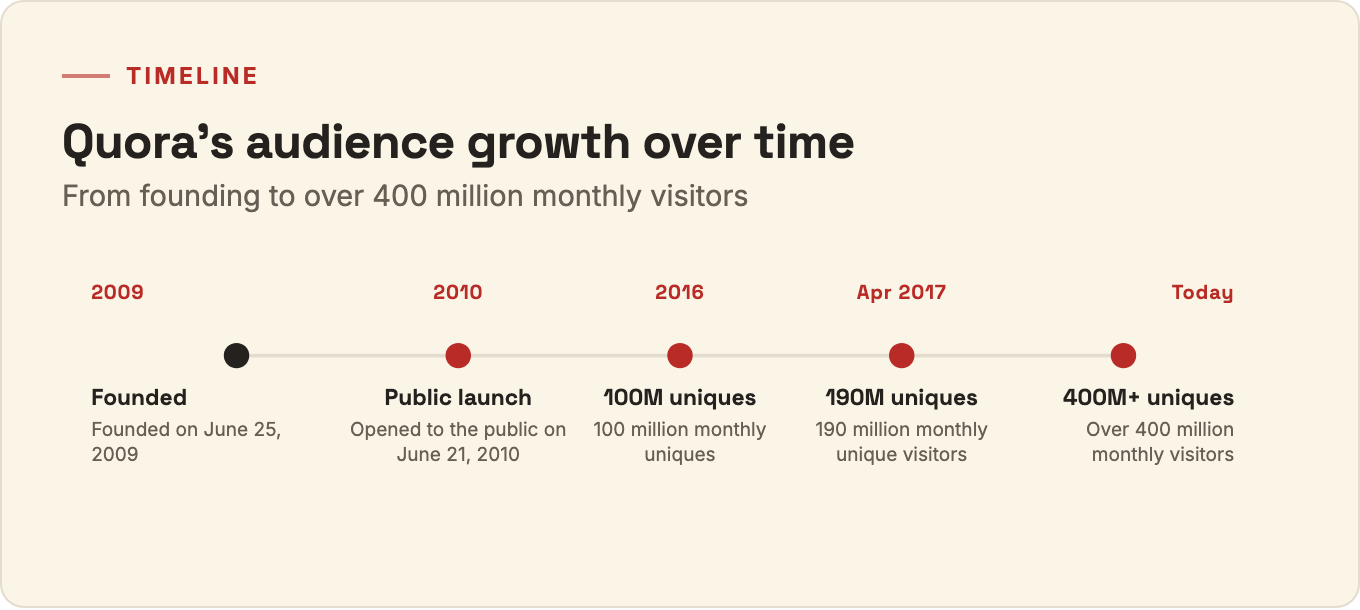
Quora's audience has grown steadily for over a decade. The platform was founded on June 25, 2009 and opened to the public on June 21, 2010, built by former Facebook employees Adam D'Angelo and Charlie Cheever. In April 2017 it claimed 190 million monthly unique visitors, up from 100 million a year earlier, and today Quora reports over 400 million.
The trajectory matters because it shows durability. Many question-and-answer and forum sites peaked and faded; Quora roughly doubled its monthly audience between 2016 and 2017 and has continued to grow to the 400 million-plus figure it reports now. For a marketing channel, longevity plus a rising audience is a better bet than a platform still proving it can hold users.
There is a second reason the history is useful. A platform that has compounded its audience for more than fifteen years, from public launch in 2010 through 100 million monthly uniques in 2016 to over 400 million today, has also had time to accumulate a deep back catalog of ranked answers. Content you publish joins a library that Google already trusts and indexes heavily. That is part of why answers keep pulling traffic: they inherit the domain authority the platform has built up over a decade and a half.
Why does Quora's audience matter for marketers?
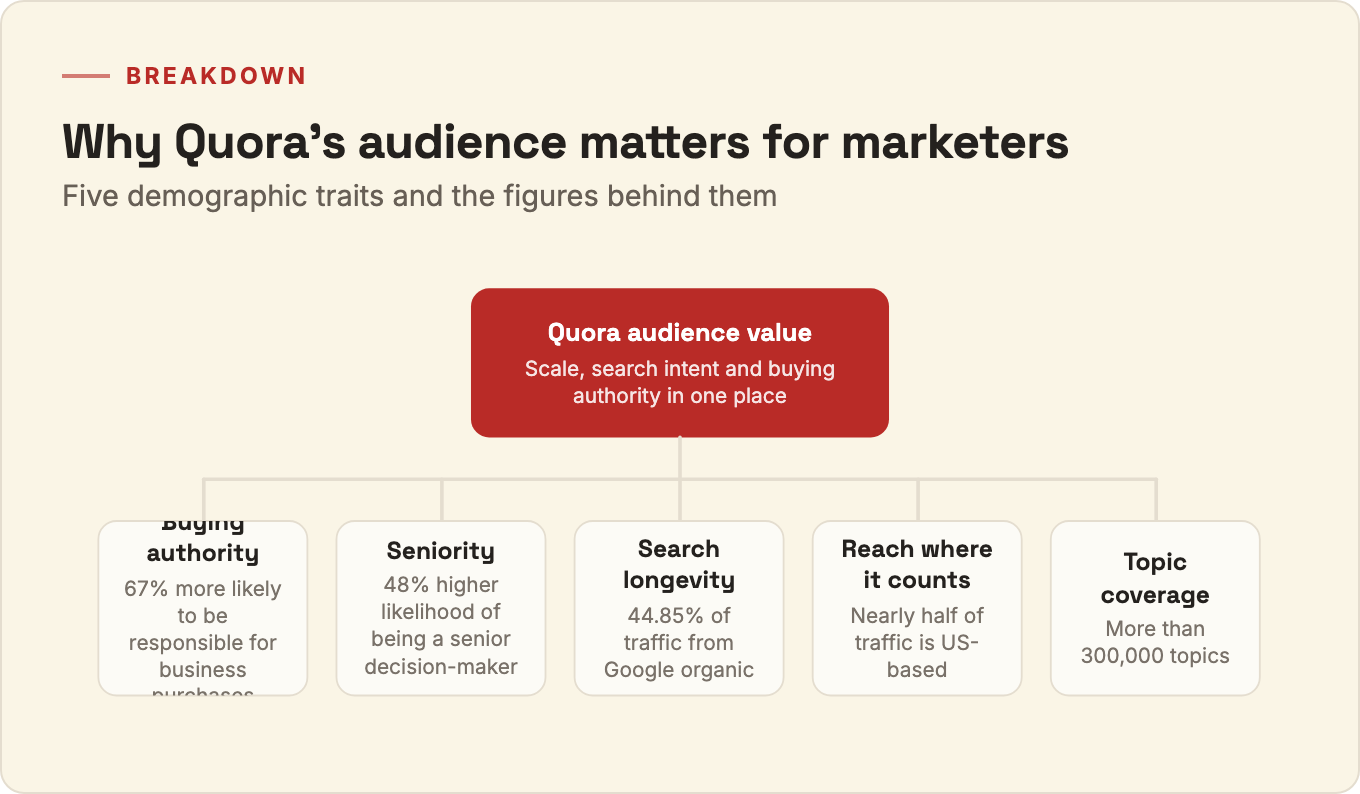
Quora's audience matters because it combines scale, search intent and buying authority in one place. You get hundreds of millions of monthly visitors, most of them arriving with a specific question, and a disproportionate share of them controlling business purchases or holding senior roles. Few other public platforms put those three traits together.
Here is how the demographics translate into practical value:
- Buying authority. Visitors are 67% more likely to be responsible for business purchases, so your message can reach the person who actually signs off.
- Seniority. A 48% higher likelihood of being a senior decision-maker means less time spent reaching people who cannot act.
- Search longevity. With 44.85% of traffic from Google organic, well-placed answers keep working long after they are published.
- Reach where it counts. Nearly half of traffic is US-based, with strong UK, Canadian and Indian audiences for English-language campaigns.
- Topic coverage. More than 300,000 topics mean your category almost certainly already has active, search-visible threads.
The catch is that this audience is there to get answers, not to be sold to. The buyer and decision-maker skew is only useful if you show up as a genuinely helpful voice on the questions your customers are already asking. Answers that read as ads get ignored or downvoted; answers that solve the problem earn the click.
It is also worth being honest about what the demographics do not promise. A large, senior audience is a reason to invest, not a guarantee of results. The value only appears when the platform's traits line up with your business: buyers in the US, UK, Canada or India, a product that answers a real research question, and the patience to build answers that rank and keep earning traffic. Where that fit exists, the payoff compounds. Where it does not, the same numbers will underdeliver, so the demographics are best used as a screening test before you commit time and budget.
Turning Quora's demographics into results
The numbers make a clear case: Quora reaches a large, search-driven, professionally senior audience that skews toward business buyers, concentrates in the US and other English-speaking markets, and centers on the 25 to 34 age group. If those are the people you sell to, the platform is worth serious attention.
Knowing who uses Quora is the first step. The harder part is showing up on the right questions, in a way that reads as helpful rather than promotional, and building answers that keep earning search traffic over time. If you want that handled properly, see how we approach Quora marketing for business and turn this audience into qualified visitors and leads.