

Quora generative engine optimization (GEO) is the practice of writing and structuring Quora answers so that AI search engines like ChatGPT, Perplexity, and Google's AI Overviews can extract, trust, and cite them. It matters because a growing share of buyer research now happens inside these engines, and they build answers by pulling from public web sources rather than sending every user to a ranked list of blue links. If your expertise is not present in a form these systems can quote, you are absent at the exact moment a decision is being made.
What is generative engine optimization?
Generative engine optimization is the discipline of shaping content so that AI-driven search tools surface it and cite it in their answers. The term comes from a 2024 research paper, GEO: Generative Engine Optimization, which defined the problem and measured what actually changes how often a source gets used.
The researchers describe how these tools work in one line:
Generative Engines typically satisfy queries by synthesizing information from multiple sources and summarizing them using LLMs.
In plain terms, the engine does not just rank pages. It reads several of them, writes a single answer, and attributes parts of that answer to the sources it drew from. The same study found that deliberate optimization can, in its words, "boost visibility by up to 40% in generative engine responses." That number is why GEO is now treated as its own field alongside traditional SEO, and why Quora GEO deserves a dedicated playbook rather than being folded into generic content marketing.
Why do AI search engines pull answers from Quora?
AI search engines pull from Quora because they assemble answers from many public web sources, and Quora is one of the largest question-and-answer corpora on the open web. Its format also happens to match how these systems read and attribute content.
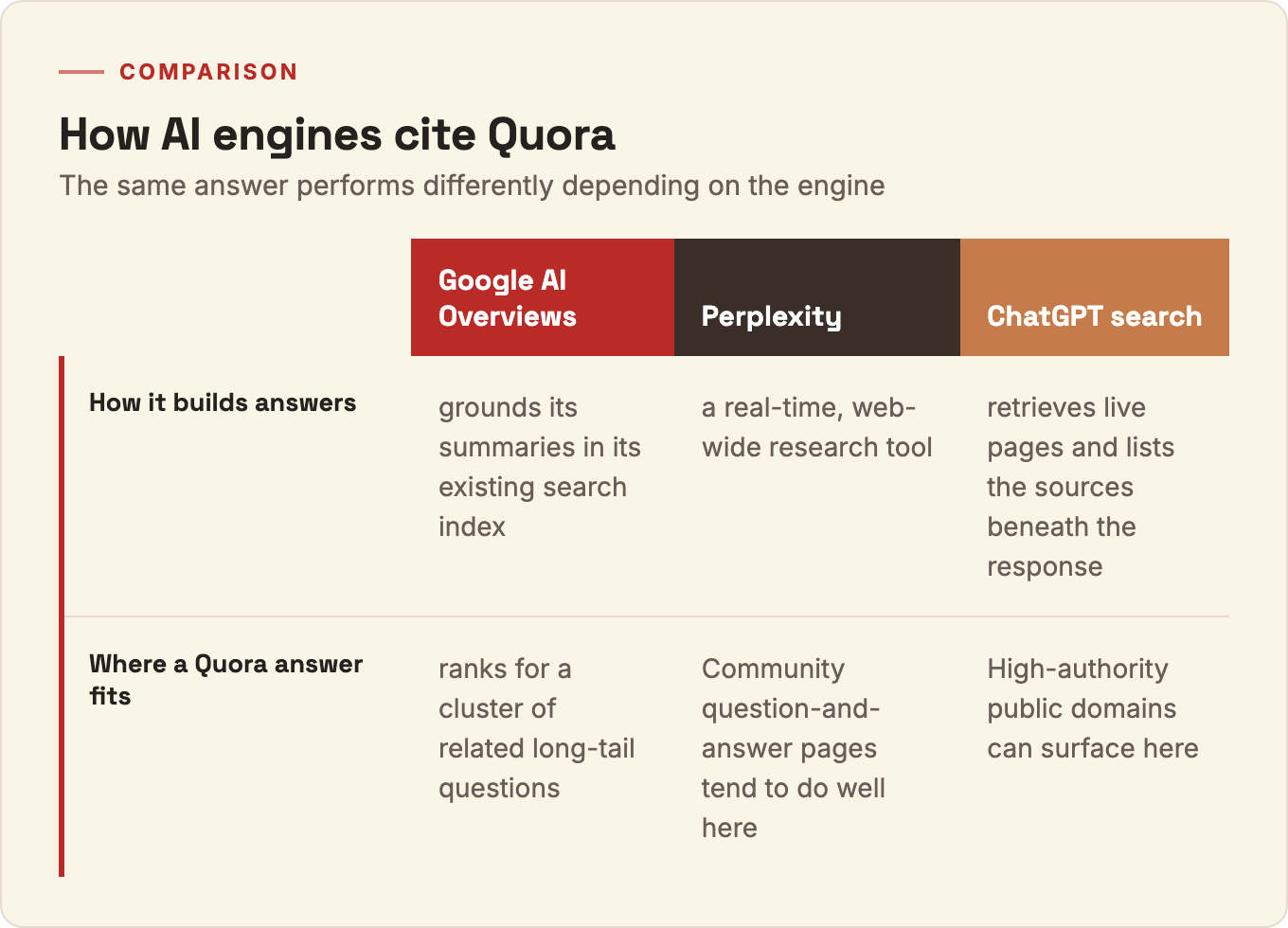
Consider how the engines gather material. Google says its AI features may use a "query fan-out" technique, issuing multiple related searches across subtopics and data sources to build a single response, according to Google Search Central. Perplexity, in its own developer documentation, describes its product as "unparalleled real-time, web-wide research and Q&A capabilities." ChatGPT search works the same way at a high level: it retrieves live pages and shows the sources beneath the answer. In every case the engine is looking for pages that directly answer a question, and a Quora question thread is exactly that.
Quora itself makes the structural argument. On its business resource for AI search, Quora notes that the question-and-answer layout "maps directly to how AI systems parse and attribute content, and it also happens to be the native format of Quora, where millions of professionals ask and answer questions every day." That is the core of the Quora GEO thesis. A clear question with a direct, self-contained answer is the unit these engines are built to extract.
Which AI engines cite Quora, and how do they differ?
The three engines most brands care about, Google's AI Overviews, ChatGPT search, and Perplexity, all cite external sources, but they gather and weight them differently. Understanding those differences keeps Quora GEO honest, because the same answer can perform very differently depending on the engine.
Google AI Overviews and AI Mode. Google grounds its summaries in its existing search index. Because it may use query fan-out to run several related searches at once, a Quora thread that ranks for a cluster of related long-tail questions has more chances to be pulled into a single response. The eligibility bar is the same as classic search: the page must be indexed and snippet-eligible, and Google says no special markup is required.
Perplexity. Perplexity is built as a real-time, web-wide research tool that returns answers with citations to the sources it used. Community question-and-answer pages tend to do well here because they contain direct, conversational answers to the kind of questions people type into an answer engine.
ChatGPT search. When ChatGPT searches the web it retrieves live pages and lists the sources beneath the response. High-authority public domains can surface here even when a brand's own new page does not yet carry enough trust on its own, which is part of why an answer on an established platform like Quora is worth having.
The common thread is that all three reward a credible page that answers the exact question cleanly. That is the target Quora GEO aims at, regardless of which engine is in front of the user this quarter.
How do generative engines decide which sources to cite?
Generative engines retrieve many candidate pages, then rank and cite only a handful based on relevance, structure, and trust. Getting into that shortlist, not just ranking somewhere on page one, is the goal of Quora for AI search.
Two eligibility rules are worth knowing. First, a page has to be reachable at all. Google states that to appear as a supporting link in AI Overviews or AI Mode, "a page must be indexed and eligible to be shown in Google Search with a snippet." Second, there is no secret file or markup to game. Google is explicit that "there are no additional requirements to appear in AI Overviews or AI Mode, nor other special optimizations necessary." The signals that earn a citation are the same ones that earn a good ranking: clarity, relevance, and credibility.
Beyond eligibility, the GEO research measured which content traits move a source up the shortlist. It found that features such as authoritative language, cited sources, quotations, and relevant statistics can raise how often a page is used, and, importantly, that "the efficacy of these strategies varies across domains, underscoring the need for domain-specific optimization methods." There is no single trick. The right mix depends on the topic, which is why Quora answers in a technical or regulated niche need different framing than answers in a consumer category.
The table below maps those research-backed signals onto what they look like inside a real Quora answer.
| Citation signal | What it looks like in a Quora answer | Why it helps |
|---|---|---|
| Direct answer first | The first sentence answers the question before any context or story. | Engines extract self-contained passages; a buried answer is harder to quote. |
| Cited sources | Links or named references to primary data, standards, or documentation. | The GEO study found citing sources raises how often content is used. |
| Statistics and specifics | Concrete numbers, dates, and named examples instead of vague claims. | Specific figures give an engine something precise to attribute. |
| Authoritative, plain language | Confident, jargon-light explanation from a named practitioner. | Authoritative phrasing was one of the traits that improved visibility. |
| Clean structure | Short paragraphs, lists, and one idea per block. | Well-structured passages are easier to parse, snippet, and cite. |
What makes a Quora answer extractable and quotable?
An extractable Quora answer states its conclusion in the opening line, then supports it with evidence a machine can lift out of context. The test is simple: if an engine copied any single paragraph into an answer, would it still make sense and still be correct on its own?
In practice, that translates into a handful of habits that align with both the GEO findings and how people actually read Quora:
- Lead with the answer. Put the one-sentence takeaway first, then explain. Reversing the usual build-up-to-a-conclusion structure is one of the biggest levers for citability.
- Answer one question per answer. A focused response to the exact question asked is more extractable than a sprawling essay that touches ten things.
- Back claims with sources and numbers. Reference primary data or documentation rather than asserting. This is a research-validated GEO tactic, not just good manners.
- Write for a named human. A real practitioner byline with genuine experience carries the authority and first-hand signals that AI engines and Quora readers both reward.
- Keep passages self-contained. Avoid answers that only make sense if you read the three paragraphs above. Each block should stand alone.
A quick example makes the difference concrete. An answer that opens with "It depends on your setup, but let me walk through the history first" gives an engine nothing clean to lift. An answer that opens with "For most B2B teams, the break-even point is around 50 seats, and here is why" hands the engine a self-contained, attributable statement it can quote directly. Same expertise, very different odds of being cited.
None of this is about tricking a model. It is about writing genuinely useful answers in a shape that machines can read, which is also the shape that human readers prefer. That overlap is what makes white-hat Quora GEO durable rather than a loophole waiting to close.
Does Quora still matter for AI visibility in 2026?
Yes, but with a clear-eyed view of the data. Citation share on AI engines is volatile and platform-specific, so Quora is a strong channel for some engines and query types and a weaker one for others.
A 2025 study by Semrush that tracked citations across ChatGPT, Google AI Mode, and Perplexity found real movement among user-generated sites. In its words, "YouTube, Reddit, and Facebook grew the most, while Medium, Quora, and LinkedIn had the biggest declines" on Google's AI Mode during the study window. That is a useful reality check. No single platform guarantees permanent citation share, and anyone promising fixed AI ranking numbers is guessing.
The strategic response is not to chase whichever site is up this quarter. It is to build a genuinely authoritative, well-structured presence on a high-authority Q&A platform that the engines already crawl, so that when your topic surfaces, your answer is the one that is easy to trust and easy to quote. Durable structure and real expertise survive algorithm shifts. Thin, keyword-stuffed answers do not. That is the whole case for treating Quora AI visibility as an editorial discipline rather than a volume play.
How does Quora GEO fit with Quora SEO?
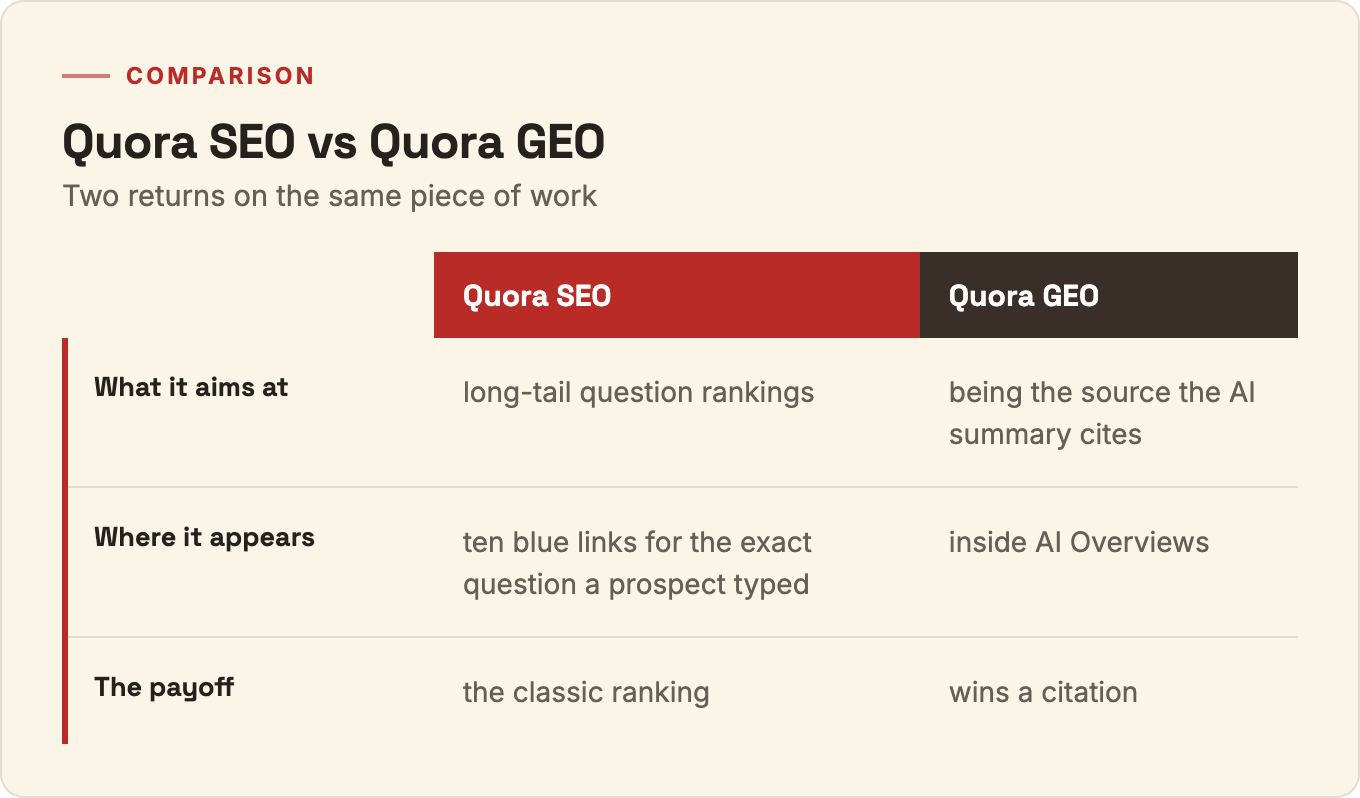
Quora GEO and Quora SEO are two returns on the same piece of work. A well-made Quora answer can rank in classic Google search and feed AI-generated answers at the same time, because both systems reward the same underlying signals.
Traditional Quora SEO aims at long-tail question rankings: a strong answer on a high-authority domain can appear in Google's ten blue links for the exact question a prospect typed. Generative engine optimization aims one layer higher, at being the source the AI summary cites. Google has said that links inside AI Overviews "get more clicks than if the page had appeared as a traditional web listing," and that "with AI Overviews, people are visiting a greater diversity of websites for help with more complex questions." So the extractable answer that wins a citation is often the same answer that earns the classic ranking. You write it once and it works in both surfaces, which is why generative engine optimization on Quora compounds rather than competing with your existing SEO.
How do you get your brand cited on Quora?
You get cited by publishing direct-answer content, from credible named experts, on the questions your buyers actually ask, and keeping it accurate over time. Quora frames the same idea from the platform side: "publishing authoritative answers in Q&A communities, particularly ones with established domain authority and human editorial signals, puts your expertise in front of AI systems as a corroborating source."
That is the work we do. We identify the questions where AI engines are already forming answers in your category, write answers that lead with the conclusion and back it with evidence, and maintain them so they stay the version worth quoting. Done properly, Quora becomes a channel that earns citations in AI answers and long-tail rankings from a single body of content, without any of the manipulative tactics that get accounts flagged.
If you want your brand to be the answer AI engines reach for, our Quora AI visibility service maps the questions that matter in your market and builds the extractable, citable answers that put you inside those responses. Get in touch and we will show you where the gaps are and what it would take to fill them.
Sources
- GEO: Generative Engine Optimization (arXiv, Aggarwal et al., KDD 2024)
- AI Features and Your Website (Google Search Central)
- Generative AI in Search: Let Google do the searching for you (Google blog)
- Perplexity API Overview (Perplexity Docs)
- How to Get Your Brand Cited by AI Search (Quora Business)
- The Most-Cited Domains in AI: A 3-Month Study (Semrush)