

Quora shows up in a Google AI Overview because it is the single most-cited domain that those overviews pull from. Independent research from Semrush ranked Quora as the #1 most-cited website in Google's AI Overviews. Google's system reads a question, finds pages that answer it clearly, and Quora happens to hold a vast library of direct, question-and-answer pages that match how people actually ask.
If you have watched a Quora ai overview appear at the top of your results and wondered why that platform keeps winning the slot, this article breaks down the mechanics behind it.
What is a Google AI Overview and how does Quora fit in?
A Google AI Overview is the AI-generated summary that sits above the traditional blue links for many searches. It answers your question in a few sentences and cites the sources it drew from. Quora fits in because its content is structured as questions with answers, which is exactly the shape these summaries are built to synthesize.
Google explains that AI Overviews are powered by a Gemini model customized for Search. That model combines multi-step reasoning, planning, and multimodality with Google's core Search systems. In plain terms, it plans out an answer, reasons across multiple pages, and stitches together a response. Quora's format gives it clean, self-contained answers to reason over.
Why is Quora the most-cited source in AI Overviews?
Quora leads because its content directly matches search intent and carries quality signals Google already trusts. The Semrush study that named Quora the top-cited domain is the clearest evidence available. When people ask real questions in natural language, Quora already has a thread answering that exact question, often with several perspectives.
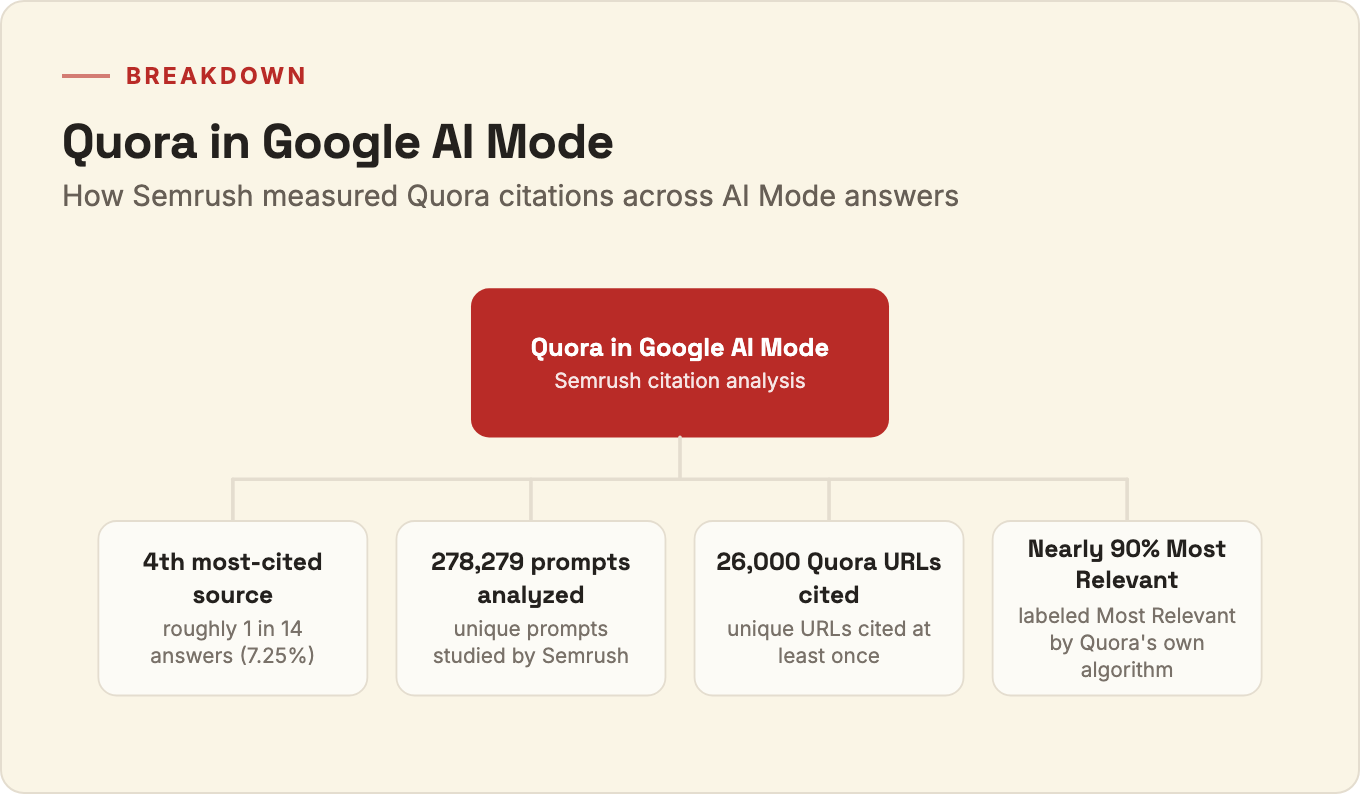
The pattern holds beyond AI Overviews. In Google's AI Mode, Semrush found Quora is the 4th most-cited source, appearing in roughly 1 in 14 answers (7.25%). That analysis covered 278,279 unique prompts and identified 26,000 unique Quora URLs cited at least once. This is not a handful of lucky pages. It is broad, repeated citation across a huge range of topics.
One finding stands out. Nearly 90% of the Quora answers cited by Google's AI Mode were labeled "Most Relevant" by Quora's own ranking algorithm. Google is leaning on Quora's internal quality signals, effectively borrowing Quora's judgment about which answer is best and surfacing that same answer in its summary.
Does appearing in Google AI Overviews require special markup?
No. Google states plainly that there are no additional requirements to appear in AI Overviews or AI Mode, and no special schema or optimizations are necessary. A page only needs to be indexed and eligible to show in Search with a snippet.
This matters for two reasons. First, it means Quora's advantage is not a technical trick. It comes from content that answers questions well and sits on a domain Google already indexes deeply. Second, it means the path to being cited is the same path as ranking in normal Search: publish a genuinely useful answer on an indexable page. Quora's scale and structure just make that easier to do at volume.
How does Quora in SGE and AI Mode compare to classic search?
Quora's presence in SGE (the earlier name for these AI experiences) and in the current AI Mode reflects the same underlying strength: question-shaped content on a trusted domain. The difference is what happens after the citation. In classic search, a Quora link is one of ten options. In an AI Overview, Quora is often the source the summary is built from, quoted or paraphrased directly in the answer the user reads first.
Here is how the two surfaces line up based on the available research:
| Surface | Quora's position | What the data shows |
|---|---|---|
| AI Overviews | #1 most-cited domain | Ranked top source by Semrush research |
| AI Mode | 4th most-cited source | Cited in ~1 in 14 answers (7.25%) across 278,279 prompts |
Both surfaces reward the same thing. A clear answer to a specific question, published where Google can find and trust it. Quora happens to be built entirely out of that raw material, which is why it keeps surfacing across every AI search format Google ships. Getting your brand into those cited answers is the core of any serious Quora AI visibility strategy.
Why does being cited in AI Overviews matter for your business?
Being cited matters because AI search is becoming a larger surface and its visitors may be worth more. Semrush projects that AI search traffic will surpass traditional organic search by 2028. That is not a distant edge case. It is the direction the whole channel is moving.
The value per visit may also be higher. Semrush estimates each AI search visitor is worth 4.4x more than an average traditional search visitor. People arriving from an AI answer tend to be further along in their decision, having already read a synthesized summary before they click. If a Quora answer feeding that summary mentions your product, you are in the consideration set at the exact moment intent is highest.
How do you get your brand into these cited answers?
The short version: put accurate, helpful information about your category into the Quora answers that Google is already citing. Since Google leans on Quora's "Most Relevant" ranking, the goal is to earn that relevance label on questions your buyers actually search. That means well-written answers, on the right questions, from credible profiles.
This is deliberate work, not luck. If you want your brand represented in the Quora answers that AI Overviews and AI Mode pull from, our Quora AI visibility service is built around exactly that outcome. We focus on the questions your market asks and the answers Google is most likely to cite, so your name shows up where the buying decision is being formed.
Sources
- New Research Ranks Quora as the #1 Most-Cited Website in Google AI Overviews (PR Newswire)
- Quora in Google AI Mode: Semrush Research
- Semrush Research Shows Quora Cited Most in Google AI Overviews (Quora Business)
- Generative AI in Google Search (Google Blog)
- AI Features in Google Search (Google Search Central)