

Quora lead generation works when you treat Quora as a place to answer real questions from people who are actively researching a purchase, not as a link-dropping channel. The people asking questions on Quora are pre-qualified by their own intent, and Google now pulls Quora answers into its AI results, so a strong answer can reach buyers long after you post it. This playbook covers what actually drives quora leads, what the platform forbids, and how to structure the work so it compounds instead of getting flagged.
Does Quora actually generate leads?
Yes, but the mechanism is indirect. You do not "buy" leads by posting. You earn attention by answering a question well, and a fraction of the people who read that answer click through, remember your name, or search for you later. The reason this scales is reach: a single answer on a popular question keeps surfacing to new researchers for months or years, and it can also get pulled into search and AI results.
That last point is not theoretical. In a Semrush study of Google's AI Mode, informed by input from Quora's team, 7.25% of AI Mode responses included a Quora link, roughly one in every 14 answers. Across 278,279 AI Mode responses analyzed, the study found 20,189 Quora citations spanning about 26,000 unique Quora URLs. Quora also ranks among the top four most-cited domains in Google AI Mode, behind only LinkedIn, Reddit, and Google. When a buyer asks an AI assistant a question in your category, a well-built Quora answer is one of the sources it may quote.
Who are Quora leads, and are they worth it?
Quora leads are people who typed a specific question into a public forum because they wanted an answer before deciding something. That intent is the whole value. Someone asking "what is the best way to handle X" is closer to a purchase than someone scrolling a feed, because they have named their problem out loud.
The trade-off is that these leads are not handed to you as contact records. You reach them by being the most useful voice on the questions they are reading. The quality tends to be high because the audience self-selects by problem, but the volume depends on how many relevant questions exist in your category and how consistently you answer them. For B2B especially, this is a strength: buyers research niche problems on Quora that never generate enough search volume for a dedicated ad campaign, and a precise answer to a narrow question can reach exactly the decision-maker you want.
It also helps to think about where the click goes. Some readers click a reference in your answer. Others read your credential, remember the name, and search for you later. A growing share never touch Quora at all and instead meet your answer inside an AI-generated result that cited it. All three are quora leads, but only the first shows up cleanly in a link tracker, which is why programs that judge Quora purely on same-session clicks tend to undercount it.
How do you generate leads on Quora without getting flagged?
You generate leads on Quora by answering the question first and completely, then letting your expertise and a single relevant reference do the selling. The platform is built to punish the opposite behavior, so understanding the rules is not optional.
Quora's policies prohibit self-promotion that is not part of a genuinely helpful answer, and they require that the gist of an answer be understandable without leaving Quora for an external website. In plain terms: your answer has to stand on its own. A link is allowed as supporting material, not as the payload. If a reader would have to click your link to get any value at all, the answer is promotional and at risk.
Two more rules shape how you work:
- Disclose affiliations. Quora requires users to disclose any relevant affiliation explicitly, either in the answer itself or in the credential shown with the answer. If you work for the product you mention, say so.
- No coordinated inauthentic activity. Quora defines spam to include vote manipulation, artificially manipulating engagement metrics, and posting the same content repeatedly. Upvote rings, duplicate answers pasted across threads, and sockpuppet accounts are the fastest way to get an account removed.
The safe pattern is simple to state and harder to do at volume: pick questions you can genuinely answer, write the answer as if no link were allowed, and only then decide whether a reference to your own resource adds anything. Most of the time it does not, and the answer performs better without it.
What makes a Quora answer that gets read (and cited)?
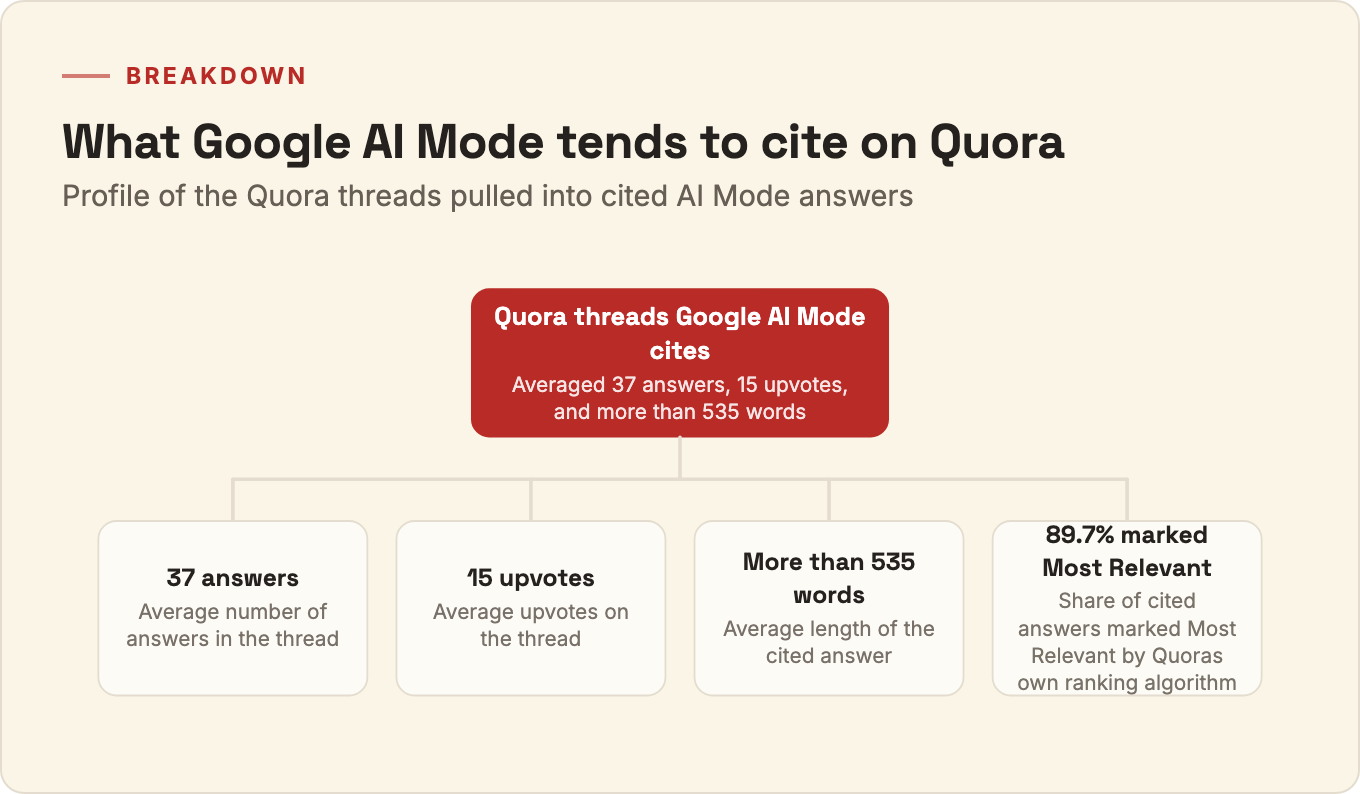
The answers that win are long enough to be complete, specific enough to be useful, and structured so a reader can extract the point in seconds. The Semrush and Quora study gives a concrete profile of what Google's AI Mode tends to cite: the Quora threads it pulled from averaged 37 answers, 15 upvotes, and more than 535 words. Engagement and depth correlate with getting picked up.
Even more telling, 89.7% of the Quora answers cited in Google AI Mode were marked "Most Relevant" by Quora's own ranking algorithm. Google appears to lean on Quora's internal quality signal. That means the same things that make an answer rank well inside Quora, being genuinely helpful and earning real upvotes, are the things that get it surfaced in AI search. You do not need two strategies. You need one good answer.
Practical markers of a strong answer:
- Open with a direct one or two sentence answer, then expand. Readers and AI systems both reward the answer-first structure.
- Aim for substance over length, but do not truncate. The cited answers cleared 535 words for a reason: they covered the question fully.
- Write from real experience and say where it comes from. First-hand detail is what a reader cannot get from a generic listicle.
- Format for scanning: short paragraphs, a list where a list belongs, one clear takeaway.
Which Quora questions should you target?
Target questions that are specific to your category, still getting views, and phrased the way a buyer would phrase a problem. The goal is relevance, not reach for its own sake. A broad question with millions of views but no commercial angle will not produce leads, while a narrow question asked by ten of your exact buyers can.
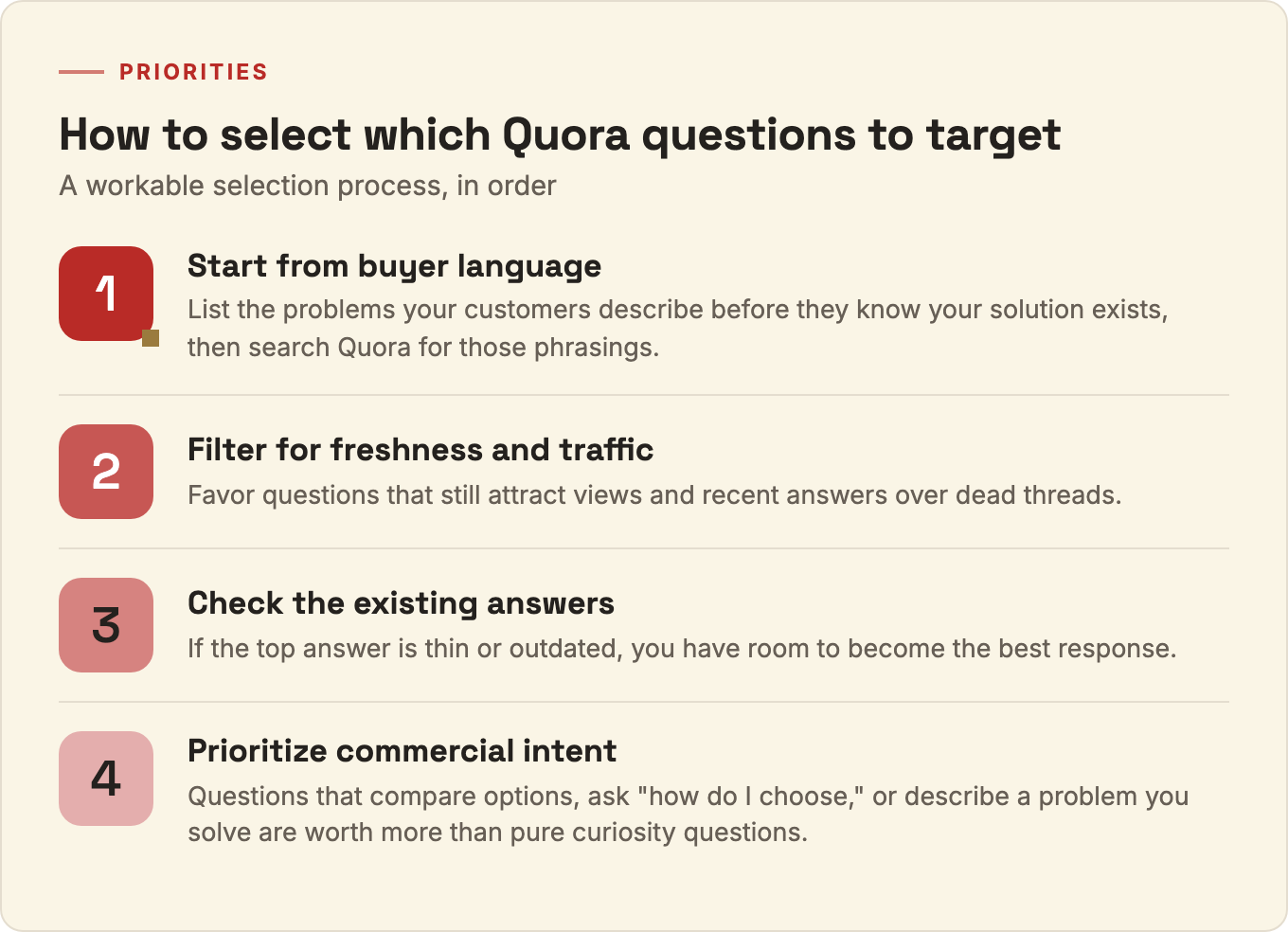
A workable selection process:
- Start from buyer language. List the problems your customers describe before they know your solution exists, then search Quora for those phrasings.
- Filter for freshness and traffic. Favor questions that still attract views and recent answers over dead threads.
- Check the existing answers. If the top answer is thin or outdated, you have room to become the best response. If it is already excellent, your effort is better spent elsewhere.
- Prioritize commercial intent. Questions that compare options, ask "how do I choose," or describe a problem you solve are worth more than pure curiosity questions.
This is the part that separates a real program from random posting. Sustained results come from a maintained list of the right questions and a steady cadence of answering them, which is the core of any serious Quora program for business. Treat the question list as a living asset. New questions get asked constantly, top answers go stale, and a thread that was not worth your time last quarter can open up when its best answer ages out. Revisiting the list on a schedule is what keeps the program producing instead of stalling after an initial burst.
How does organic Quora compare to Quora's paid options?
Organic answering builds durable presence and citations over time, while Quora's paid products buy speed and direct capture. They solve different problems, and mature programs often run both.
On the organic side, one underused asset is the Quora Space. A Quora Space is a place to build a dedicated community around one idea, business, or topic with complete editorial control, which lets a brand publish original content and grow a following instead of only reacting to existing questions. It turns Quora from a Q&A channel into an owned audience.
On the paid side, Quora offers Lead Gen Forms. These let advertisers capture customer intent the moment someone is researching on Quora, collecting information without disrupting the browsing experience. Where organic answers earn attention slowly and compound, paid forms convert existing intent immediately, at a cost per lead. Neither replaces the other. Organic builds the reputation that makes paid convert better.
The simplest way to frame it: organic answers are why people trust you, paid forms are how you collect them when they are ready. Skipping the first makes the second expensive.
How do you get Quora B2B leads specifically?
For Quora B2B leads, narrow beats broad. B2B buyers research specialized problems that rarely have high search volume but do have specific questions on Quora, and answering those precisely puts you in front of a small, high-value audience.
What works for B2B:
- Answer implementation questions, not just category questions. "How do we handle X at scale" attracts practitioners with budget, not casual browsers.
- Lead with a credible credential. Because Quora shows your credential next to your answer and requires you to disclose affiliations, an honest, specific credential ("I run X at Y") builds trust and satisfies policy at once.
- Depth over frequency. A handful of thorough answers on the exact questions your buyers ask outperforms a high volume of shallow ones, and depth is what gets cited in AI search.
- Be patient with attribution. B2B cycles are long. A Quora answer read during early research may convert months later through a different channel, so judge the program on pipeline, not same-day clicks.
Why does answering honestly outperform gaming the system?
Honest, helpful answering outperforms manipulation because both Quora and Google reward the same underlying thing: content made for people. Google states plainly that it rewards content created primarily for people, not to manipulate rankings, and warns that content made mainly to attract search visits is not aligned with what its systems reward.
Google's guidance also clarifies how it evaluates quality. Among Experience, Expertise, Authoritativeness, and Trust, trust is the most important, and E-E-A-T is not itself a specific ranking factor but a set of signals its systems use to identify helpful content. On Quora, that trust is earned answer by answer. Because Google leans on Quora's own "Most Relevant" signal when choosing what to cite, and because Quora's spam rules target the exact shortcuts people are tempted to take, the manipulation path is both riskier and less effective than simply being the most useful voice in the thread.
The strategic conclusion is boring and correct: you cannot out-trick a system built to detect tricks. You can out-help everyone else, and that help compounds. Every genuinely useful answer earns real upvotes, gets marked relevant, and becomes eligible for citation, which pulls in more readers, which produces more of the credential-driven and search-driven leads that never show in a click report. Manipulation, by contrast, degrades the moment it is detected and takes the account down with it.
Putting it together
A realistic Quora lead generation program has four moving parts. First, a maintained list of the specific, commercial-intent questions your buyers actually ask. Second, thorough answers written to stand on their own, with disclosure where it applies and a reference only where it genuinely helps. Third, an owned surface like a Quora Space to hold the audience you build. Fourth, optional paid Lead Gen Forms to capture intent once your organic presence gives people a reason to trust you. Run consistently, this reaches buyers on Quora directly and increasingly through the AI answers that now cite it.
If you would rather have this built and maintained for you, from question research through ongoing answering and measurement, that is exactly what our Quora for business service does. Start there to turn Quora from an occasional experiment into a steady source of qualified leads.