

Quora marketing for startups means answering the real questions your buyers already ask, so your product shows up at the moment of intent. It works because Quora indexes content by question, which puts your answers in front of people searching for a solution and, increasingly, in front of the AI engines that summarize those searches. For an early-stage company with no traffic and no brand, that is a cheap way to reach demand you did not create.
Why should startups care about Quora marketing?
Startups should care because the platform reaches business buyers at scale and feeds both traditional and AI search. Independent traffic estimates put Quora at roughly 292.6 million visits over a recent three-month period, so the distribution is real, not niche. The audience also skews toward the people startups want to sell to. On its own B2B page, Quora reports that 30% of its users are decision-makers at work, and that users are 81% more likely to be responsible for company strategy. That is a rare combination: a large public surface where the readers include the buyers who sign off on purchases.
There is a second reason that matters more each quarter. Google now explicitly rewards forum and community content that carries first-hand experience. In its guidance on ranking, Google notes that helpful information often lives in a comment in a forum thread or a post on a little-known blog, and it surfaces these as hidden gems. A specific, honest Quora answer from a founder can rank for a question your marketing site never will.
How does Quora feed AI search results?
Quora feeds AI search because its question-and-answer format is exactly what large language models are trained to extract from. Quora's own guidance states that its question-indexed format is one AI models are trained to extract from, and that answers can be cited directly by Perplexity and Google AI. In other words, a well-written answer is not just a page a human might find; it is a passage an AI engine can quote.
The measured weight backs this up. An analysis of AI citation patterns found that Quora accounted for roughly 1.5% of Google AI Overviews citations overall and 14.3% of the top-10 cited sources. Community Q&A is not a fringe input to AI answers; it is one of the more frequently cited source types. For a startup, that means a single strong answer can compound: it earns direct readers, ranks in classic search as a hidden gem, and gets pulled into AI-generated summaries.
What does Quora marketing for startups actually solve?
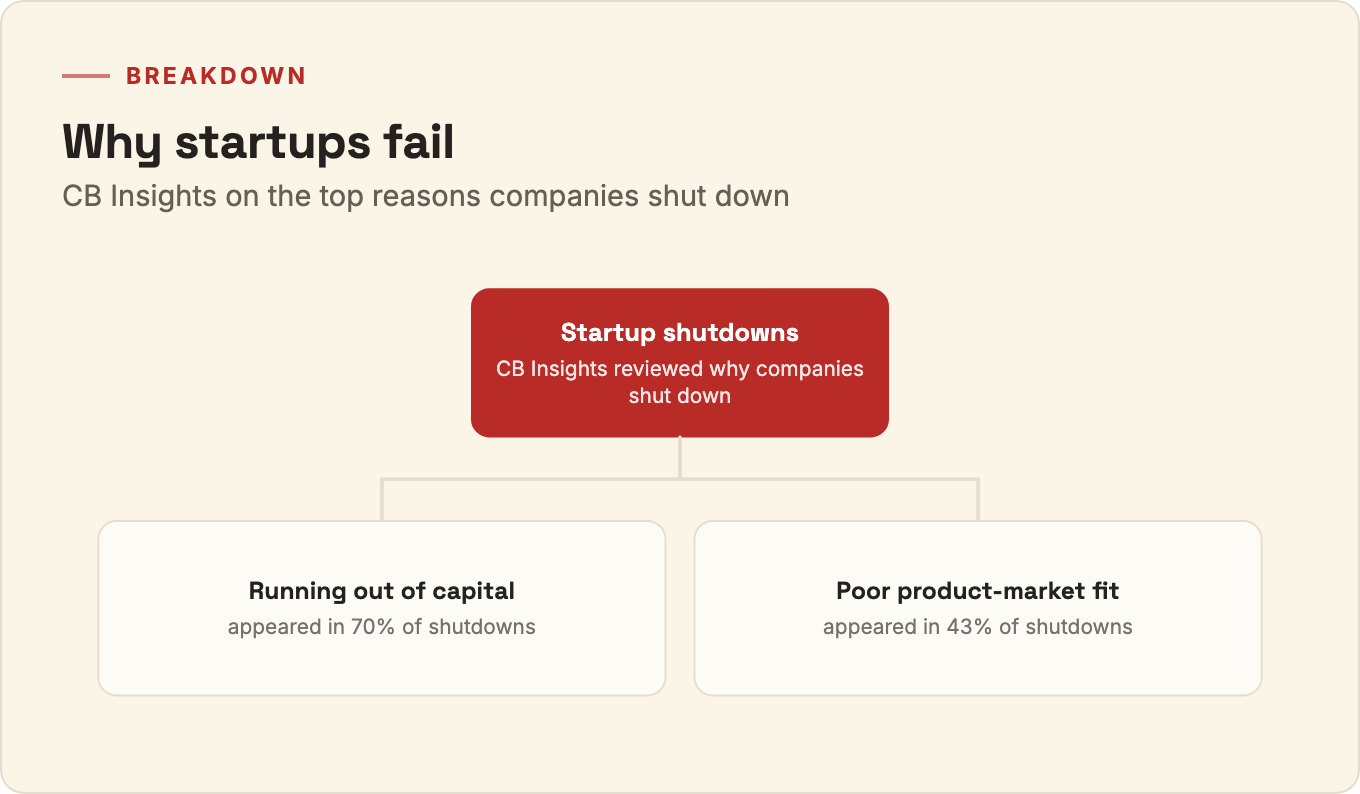
It attacks the failure mode that kills most startups: no demand and no runway. CB Insights, reviewing why companies shut down, found that running out of capital appeared in 70% of shutdowns and poor product-market fit in 43%. Paid acquisition burns the capital; weak positioning means the demand was never there. Quora sits at the intersection of both problems, because you are answering questions that prove intent without paying per click to do it.
Two things follow from that:
- You learn the market as you market. The questions people ask reveal the language, objections, and use cases your product should speak to. That is free product-market-fit research disguised as distribution.
- You spend time, not budget. Answers do not expire when you stop paying. A good one keeps earning views, rankings, and AI citations long after it is posted, which suits a company watching its runway.
How do startups get started with Quora?
Start narrow, answer as a person, and let the strongest answers compound. The mechanics are simple, but the discipline is where most founders go wrong.
- Find the right questions. Look for questions where your product is a genuine answer and where existing answers are thin, dated, or generic. Volume matters less than intent.
- Answer with first-hand experience. This is what Google rewards and what readers trust. Show the specific problem, the tradeoffs, and what you actually did, not a sales pitch.
- Lead with the answer. Open with a direct response in the first sentence or two, then add detail. That structure reads well for humans and is easy for AI engines to extract and cite.
- Link sparingly and honestly. A relevant link to your product belongs in an answer that stands on its own without it. Answers that exist only to plant a link get ignored or removed.
- Repeat on your best-performing topics. Once a question theme drives readers, cover the adjacent questions around it.
How is this different for B2B and SaaS startups?
For startups selling software, the fit is tighter because the buyers are already on the platform and the buying questions are specific. A founder can answer real evaluation and comparison questions that a landing page cannot address credibly. If that describes your company, the deeper playbook lives in our guide to Quora marketing for SaaS, which covers question selection, funnel mapping, and measurement for software products.
Is Quora marketing worth it for an early-stage startup?
For most startups, yes, because the cost is time rather than ad spend and the output keeps working. You reach decision-makers, you rank as a hidden gem in classic search, and you earn citations in AI answers, all from the same set of well-written responses. The catch is that it rewards patience and honesty, not volume. Founders who treat it as a link-dropping channel see nothing; founders who treat it as answering their market see compounding returns.
If you want this run properly rather than as a side task, our team can build and execute the program for you. See how we approach Quora marketing for SaaS and startups to turn buyer questions into a durable source of qualified traffic and AI visibility.