

The quora marketing tips that actually work all point in one direction: answer the question honestly, prove you know what you are talking about, and let the credibility do the selling. Quora rewards genuinely helpful answers and penalizes thinly veiled ads, so the winning play is to be the most useful voice in a thread, not the loudest promoter. Everything below builds on that.
What makes a good Quora answer?
A good Quora answer is clear, credible, and directly addresses the question that was asked. Quora's own guidance says an answer is helpful when it does exactly that, and that the goal is to be useful to both the person who asked and to anyone with the same question later (Quora Help Center).
That last part matters more than most marketers realize. A Quora thread can keep pulling in readers for years, and it can surface in Google and in AI answers long after you publish. So you are not writing for one asker in one moment. You are writing the reference answer that future searchers land on.
Build credibility into the answer
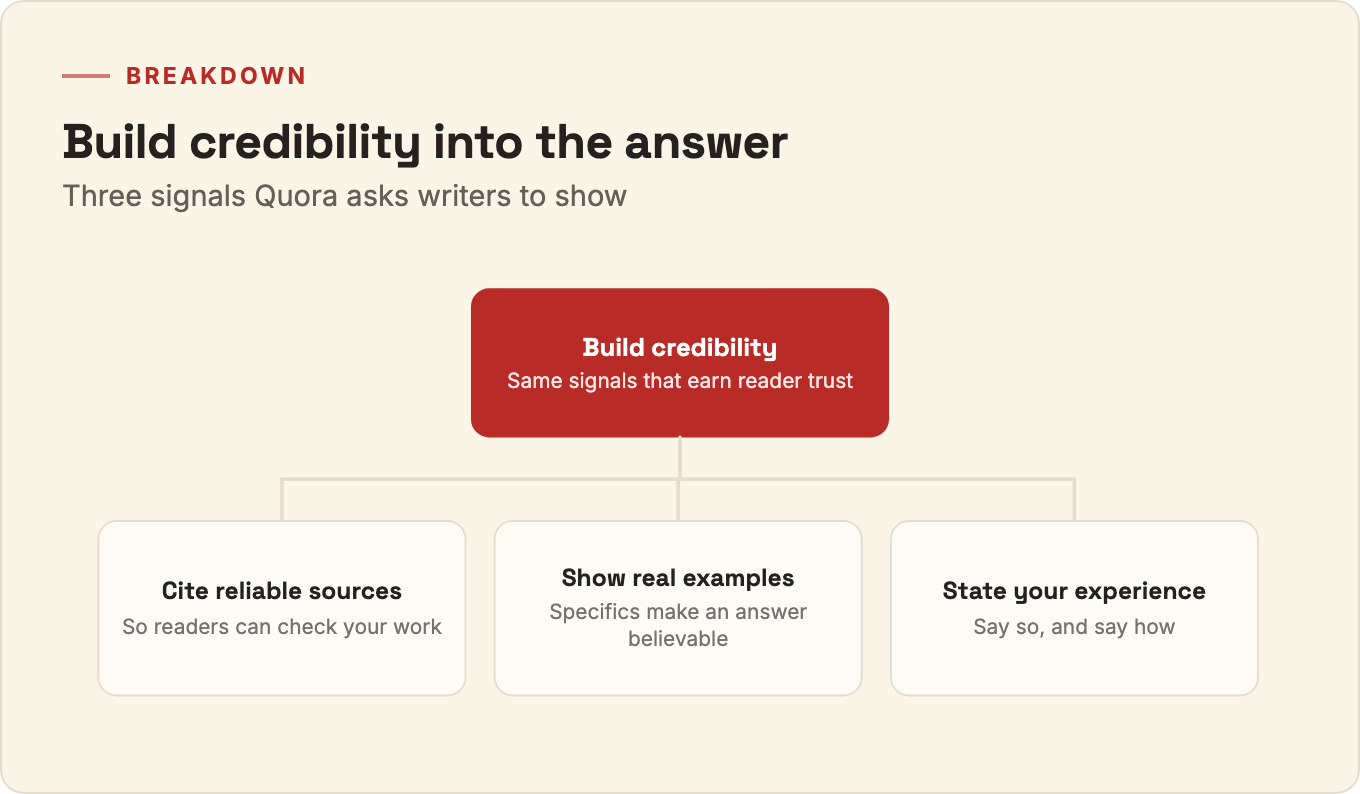
Quora tells writers to demonstrate credibility by citing reliable sources, giving good examples, and explaining their expertise or first-hand experience. That is the same set of signals that earns trust from readers and gets an answer picked up elsewhere. Concretely:
- Cite reliable sources when you make a factual claim, so readers can check your work.
- Show real examples instead of generic advice, because specifics are what make an answer believable.
- State your experience plainly. If you have done the thing, say so and say how.
Quora marketing tips for staying inside the rules
The core rule is simple: your answer has to stand on its own without pushing readers off the platform. Quora defines spam as content whose purpose is to drive traffic to external commercial sites while giving little value back to the community, and blatant self-promotion breaks that rule (Quora Q&A Policies).
Two practical constraints follow from that policy:
- The answer must be understandable without leaving Quora. Quora states the gist of an answer should be graspable without clicking out to an external site. Treat any link as a footnote, not the point.
- Promo-only answers count as spam. A link is fine only when it is part of a genuinely helpful response, not the reason the response exists.
The mindset that keeps you safe is straightforward. Write the answer you would write if links were not allowed at all. If it still helps the reader, you are on the right side of the policy. If it collapses without the link, it was an ad.
How do you actually get traffic without self-promoting?
You earn it by being the most trustworthy answer in the thread, which is the same standard search engines use. Google says its systems reward content that shows experience, expertise, authoritativeness, and trustworthiness, and that of those, trust is the most important (Google Search Central). An answer built to be trusted is an answer built to rank and to convert.
Google also frames the winning approach as people-first content, meaning content created primarily for people rather than to manipulate rankings. That is a useful test for every Quora answer you write. If a real person would thank you for it, it will do its job. If it reads like it was engineered for reach, both readers and algorithms tend to discount it.
The best-practices checklist
These Quora best practices compress everything above into a repeatable routine:
- Answer the exact question first. Lead with a direct response in the first sentence or two, then add detail.
- Back claims with sources and examples. Credibility is a choice you make in every paragraph.
- Write for the future searcher, not just the asker, so the answer keeps earning attention.
- Keep the value on-platform. Any link should be optional context, never the payoff.
- Skip the hype. People-first, plainly written answers are the ones that get trusted.
Is Quora worth the effort?
Yes, because the audience is large and the answers keep working long after you post them. Over 400 million unique visitors come to Quora every month looking for answers (Quora Business), which is a substantial audience to become visible to when your answer is the helpful one.
There is a second payoff that is easy to miss. Quora answers surface in AI search. An Ahrefs analysis found Quora appeared in roughly 3.6% of Google's AI Overview responses, more than in the other AI engines it looked at (Ahrefs). A well-crafted answer can be pulled into AI results, putting your expertise in front of people who never open Quora themselves. That is more reason to make each answer credible and self-contained.
Turning tips into a program
Applied once, this Quora marketing advice earns you a good answer. Applied consistently across the questions your buyers actually ask, it becomes a channel. The hard part is not knowing the rules. It is doing the research, writing at this standard, and keeping it up week after week without slipping into self-promotion.
That is the work our Quora marketing agency does day in and day out: finding the right questions, writing answers that earn trust, and keeping every one of them inside Quora's policies. If you want Quora working as a real channel instead of a side project, talk to our team and we will map out where your best answers should live.