

A Quora Space is a place where you can build a dedicated community around one idea, business, or topic, with complete editorial control over what gets published there. Think of it as a branded hub inside Quora, where an owner and a small group of trusted contributors decide which answers, posts, and shared links appear. Followers then see that content in their feed. For a business, a Quora Space is a way to own a corner of Quora rather than just answering questions scattered across the site.
This guide explains what Quora Spaces are, how the roles and permissions work, how content gets published, and where Spaces fit into a business marketing plan. Everything here is drawn from Quora's own documentation and public announcements.
What are Quora Spaces?
Quora Spaces are community hubs on Quora built around a single subject, brand, or interest, and the person who runs the Space has full editorial control over the content inside it. Quora describes a Space as "a place where you can build a dedicated community around one idea, business or topic, with complete editorial control." That editorial control is the key difference between a Space and the open question-and-answer flow that most people associate with Quora.
On the open part of Quora, anyone can answer any question. Inside a Space, publishing is gated. The Space decides who contributes and what stays up. That makes a Quora Space closer to a curated publication or a niche community than to a free-for-all forum. Followers of a Space get its content delivered to their Quora feed, which gives an active Space a repeatable way to reach the same audience again and again.
Because a Space carries a name, a description, and a consistent stream of content, it also works as a home base for a brand. Instead of a business presence living only in one-off answers, a Space collects that presence in a single, followable destination.
It helps to hold two ideas side by side. Regular Quora is open: questions and answers flow from the whole community, and no single person decides what belongs. A Space inverts that. The people who run it set the topic, choose who can publish, and approve or reject what outsiders submit. You are trading the reach of an open free-for-all for the control of a curated feed, and for a business that trade is usually worth making, because control is what protects a brand's tone and accuracy over time.
How do Quora Spaces work?
Quora Spaces work through a defined role hierarchy that controls who can post, who can approve submissions, and who simply reads along. Every Space starts with an owner, and from the People tab the owner can invite others into specific roles: admins, moderators, contributors, and followers. Each role carries a different level of permission, and that structure is what lets a Space stay curated as it grows.
Here is how the main roles line up:
| Role | What they can do |
|---|---|
| Owner | Creates the Space and invites people into every other role from the People tab. |
| Admin | Manages the Space, including reviewing and approving submissions from non-contributors. |
| Moderator | Helps keep content and discussion in line with the Space's standards. |
| Contributor | Can publish content directly, and is the only role allowed to answer questions posed to the Space. |
| Follower | Reads the Space, controls how it appears in their feed, and can mute it. |
Who can publish inside a Space
Contributors are the only people who can answer questions posed to a Space, and that single rule is how a Space keeps editorial control. When a question is directed at the Space, the wider Quora public cannot jump in to answer it. Only the contributors the Space has approved can respond. This is what stops a business Space from filling up with off-topic or low-quality answers.
How non-contributors take part
People who are not contributors can still submit posts or shares to a Space for admin approval. When an admin accepts a submission, it is published directly to the Space. So the door is not closed to outside voices, but everything from a non-contributor passes through a review step first. That approval gate is the practical mechanism behind the "complete editorial control" Quora promises. Good outside contributions can get in; nothing gets published without a check.
In practice this gives a Space two lanes for content. Contributors publish directly, which is fast and suited to the people you trust most. Everyone else routes through the submission queue, which an admin clears. That split lets a Space open itself to the wider community for volume and variety while still keeping a human hand on the final decision. It is the same principle a magazine uses when it accepts pitches but keeps an editor between the pitch and the printed page.
What followers control
Followers decide how much of a Space they see. They control how a Space shows up in their feed, and they can mute any Space they no longer want to follow. A Space can be muted from its main page or straight from a piece of content in the feed. For anyone running a Space, that is a useful reminder: followers stay because the content is worth it, and they can quietly opt out the moment it stops being relevant.
How to keep a Quora Space active
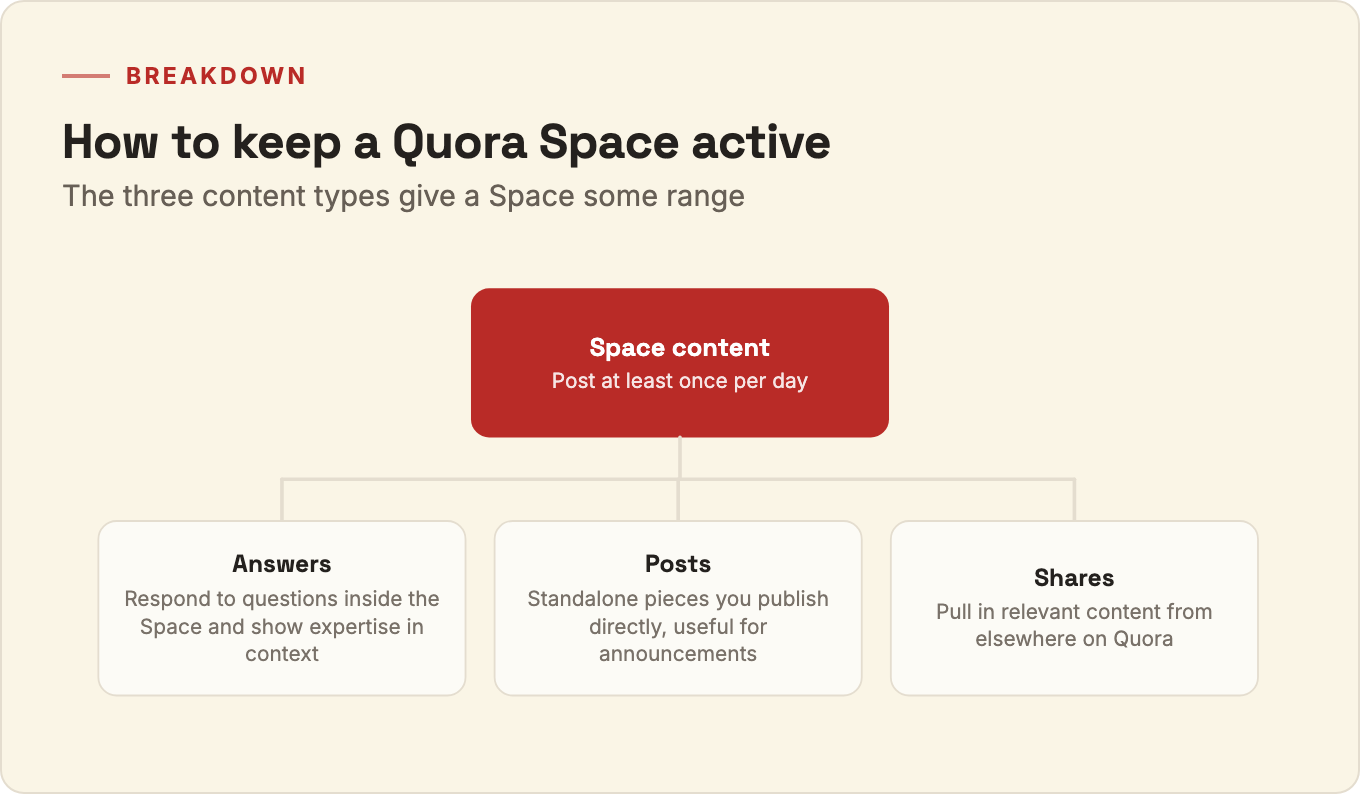
Quora recommends posting at least once per day to keep followers engaged, and that content can take the form of answers, posts, or shared links. A Space is not a set-and-forget asset. It behaves like a feed, so it rewards consistency, and it goes quiet in a follower's attention the moment new content stops appearing.
The three content types give a Space some range:
- Answers respond to questions inside the Space and show expertise in context.
- Posts are standalone pieces you publish directly, useful for announcements, short guides, or opinion.
- Shares pull in relevant content from elsewhere on Quora, which keeps the feed active without writing something new every day.
Mixing these makes daily publishing realistic. Not every day needs an original long answer. A share or a short post keeps the Space present in feeds while you save the heavier writing for the questions that matter most. If keeping that cadence sounds like a lot, that is exactly the ongoing work a managed Quora profile management service is built to carry.
Why Quora Spaces matter for reach
Content published in a Space can reach a large audience, because, by Quora's own count, over 400 million unique visitors come to the site every month looking for answers. A Space plugs into that existing traffic rather than starting an audience from zero. When your content answers real questions well, it can surface both to Space followers and to the much larger pool of people searching Quora for those topics.
There is a second, newer reason Spaces may matter. According to one study, Quora content is surfaced more often by Google's AI Overviews than by other AI engines. In that analysis of 2,000 keywords across 20 niches, run by SE Ranking between February 26 and March 3, 2025, Quora was almost exclusively cited by Google's AI Overviews and rarely by ChatGPT or Perplexity. For a business, that means well-placed Quora answers can end up quoted inside Google's AI answers, putting your perspective in front of searchers before they click anything. That is a meaningful reason to treat Quora as more than an afterthought.
Those two signals reinforce each other. The monthly visitor number tells you the audience is already there and already searching for answers. The AI Overviews finding tells you Quora is one of the sources Google reaches for when it assembles those answers. Content that lives in a well-run Space is positioned to benefit from both at once: it can pick up direct readers from Quora's own traffic and get pulled into the AI-generated summaries that increasingly sit at the top of Google's results. Neither guarantees a result on any single post, but together they explain why a Quora presence can pay off well beyond the platform itself.
Can you make money from a Quora Space?
Yes, Quora Spaces can be monetized through paid memberships. When Quora launched Space subscriptions in August 2021, it took only a 5% cut, letting creators keep more subscription revenue than on other platforms. That means a Space can charge followers for access to premium content, and the platform's share of that revenue was set deliberately low.
Quora framed the feature around content quality rather than pure monetization. CEO Adam D'Angelo described subscriptions as a way to raise the bar: by letting creators earn from the knowledge they share, Quora aims to help them create more and better content for everyone, whether or not someone is a paying member. For a business, subscriptions may or may not fit the model, but the underlying point stands. A Space that consistently publishes strong, useful content is the kind of asset the platform is built to reward.
The low platform cut is worth sitting with for a moment. Keeping the vast majority of subscription revenue changes the math on whether a paid tier is worth running, and it signals that Quora would rather grow the volume of quality content than take a large slice of any single creator's earnings. Even if you never charge a cent, the takeaway is the same: the platform's incentives point toward Spaces that publish well and often, which is exactly the behavior that also drives followers and search visibility.
Quora Spaces for business
For a business, a Quora Space turns scattered activity into an owned, followable presence built around your topic. Rather than leaving your brand's expertise spread across unconnected answers, a Space collects it in one place, gives you control over what appears, and delivers that content to a following you build over time. That combination of editorial control, a built-in audience Quora puts at over 400 million monthly visitors, and the visibility in Google's AI Overviews that one study observed is what makes Spaces worth a business's attention.
A few points are worth keeping in mind before you commit:
- It takes real cadence. Quora's own advice is to post at least once per day. A Space that goes dark loses followers' attention fast.
- Curation is the whole point. The role system lets you keep quality high, but someone has to run it: approving submissions, answering questions, and moderating.
- Contributors are your engine. Since only contributors can answer questions posed to the Space, deciding who holds that role directly shapes your content.
Done well, a Space compounds. Each strong answer keeps working for you in search and in AI answers long after you publish it, and a growing follower base means every new post starts with an audience. The trade-off is the ongoing effort, which is why many businesses either dedicate a person to it or bring in help. If your goal is answers that actually rank and get cited, our Quora answer marketing approach is aimed squarely at that.
Getting started with Quora Spaces
Starting a Space is straightforward: create it, write a clear description of the topic it covers, invite a few trusted contributors, and begin publishing. The harder part is what comes after, keeping the daily rhythm, curating submissions, and answering questions in a way that earns follows and search visibility. That consistency is where most business Spaces either grow or stall, and it is the part that quietly decides whether the Space becomes an asset or another dormant profile.
If you would rather have that work handled end to end, from setting up the Space to running the day-to-day publishing that keeps it visible, our Quora profile management service does exactly that. We build and maintain Quora presences that stay active, stay on-topic, and stay in front of the audience already searching Quora for what you offer.
Sources
- Quora for Business, Everything You Need to Know About Quora Spaces
- Quora Help Center, Spaces Frequently Asked Questions
- Quora for Business, Reach Over 400 Million Monthly Unique Visitors on Quora
- PR Newswire, Quora Joins the Creator Economy With a New Space Subscription Earning Option
- SE Ranking, ChatGPT vs Perplexity vs Google vs Bing Comparison Research